Understanding Retrieval-Augmented Generation (RAG)
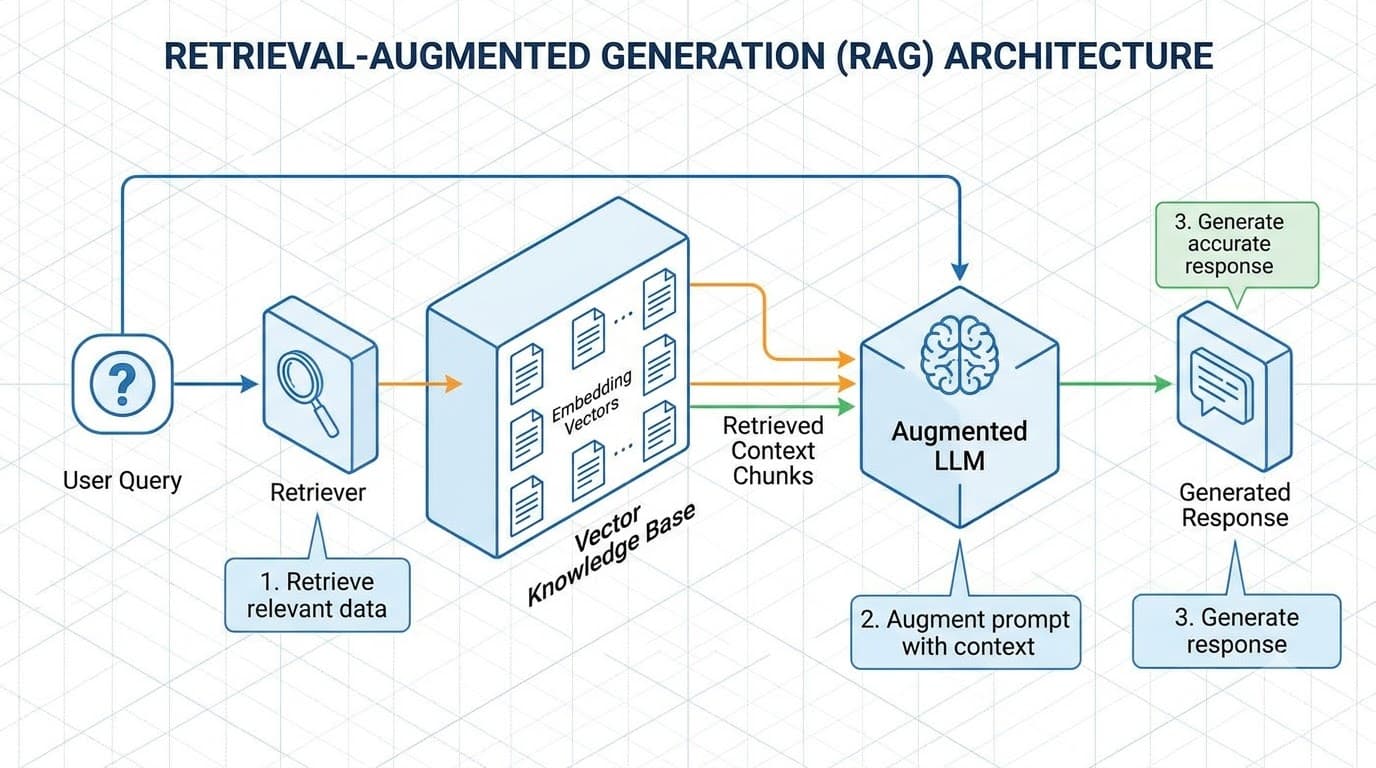

Table of Contents
- The Core Concept: Parametric vs Non-Parametric Memory
- The 3-Stage Production RAG Architecture
- Phase 1: Ingestion & Semantic Chunking
- Phase 2: Advanced Hybrid Search & Reranking
- Phase 3: Generation & Grounded Prompting
- Vector Database Landscape: 2026 Comparison
- Evaluating RAG Quality: The RAG Triad
- Frequently Asked Questions
- Conclusion
- You Might Also Like
Large Language Models (LLMs) such as Claude, GPT-4, and Llama have revolutionized modern computing with their remarkable natural language reasoning and code synthesis capabilities.
Yet, despite their billions of parameters, LLMs suffer from two fatal vulnerabilities when deployed in production enterprise environments:
- Hallucinations: The tendency to generate authoritative, fluent, but factually fabricated statements.
- Knowledge Cutoffs: The inability to access private corporate documentation, live customer records, or events that transpired after the model's training date.
Historically, organizations attempted to solve this through fine-tuning. However, fine-tuning is computationally expensive, struggles to unlearn outdated facts, and cannot provide provable source citations.
The universal architectural solution is Retrieval-Augmented Generation (RAG).
RAG bridges the gap between an LLM's parametric reasoning capabilities and dynamic, non-parametric corporate knowledge bases, guaranteeing factual grounding and auditability.
The Core Concept: Parametric vs Non-Parametric Memory
To understand RAG, we must distinguish between two types of knowledge representation in AI systems:
- Parametric Memory: The static weights and billions of floating-point parameters frozen inside the neural network during pre-training. It stores broad reasoning patterns, grammar rules, and world knowledge.
- Non-Parametric Memory: An external, dynamically updateable knowledge store—typically a Vector Database or full-text search engine containing proprietary PDFs, database schemas, and documentation.
In a RAG pipeline, the LLM is treated not as an encyclopedia, but as an analytical reasoning engine. When a user poses a question, the system queries its non-parametric memory, retrieves the most relevant factual paragraphs, injects them into the prompt's context window, and instructs the LLM: "Answer the user's question using ONLY the provided reference documents. Cite your sources."
The 3-Stage Production RAG Architecture
A production-grade RAG pipeline consists of three sequential phases: Ingestion, Retrieval, and Generation.
[ INGESTION ]
Raw Docs ──> Chunking ──> Embedding Model ──> Vector Database (pgvector / Qdrant)

[ RETRIEVAL & RERANKING ]
User Query ──> Hybrid Search (Dense Vector + BM25) ──> Cross-Encoder Reranker ──> Top-K Chunks

[ GENERATION ]
Prompt = Context Chunks + User Query ──> LLM (Claude / GPT-4) ──> Factual Cited Answer
Phase 1: Ingestion & Semantic Chunking
You cannot simply feed a 200-page PDF into a vector database as a single record. The ingestion stage prepares raw data for high-resolution retrieval:
- Text Extraction: Stripping headers, footers, and OCR-cleaning scanned documents.
- Chunking Strategy: Dividing text into discrete segments. Common strategies include:
- Fixed-Size Chunking: Chunks of 512 tokens with a 10% overlap (simple, but can sever mid-sentence context).
- Semantic / Paragraph Chunking: Splitting text along natural markdown headings, paragraphs, or sentence boundaries.
- Hierarchical Chunking (Parent-Child): Storing small chunks (128 tokens) for fine-grained vector matching, but returning the larger enclosing parent chunk (1,024 tokens) to the LLM to preserve narrative context.
- Vector Embeddings: Passing chunks through an embedding model (such as
text-embedding-3-smallorbge-large-en-v1.5) to map text into a 1,536-dimensional semantic coordinate space.
Phase 2: Advanced Hybrid Search & Reranking
Naive RAG systems rely solely on cosine similarity searches in a vector database. In production, pure vector search frequently fails on:
- Exact product serial numbers or SKUs (
ERR_TIMEOUT_502). - Acronyms and specific names (
Dr. Loc Nguyen). - Rare technical identifiers.
To solve this, modern RAG implements Hybrid Search, combining Dense Vector Search (semantic conceptual understanding) with Sparse Keyword Search (BM25 lexical precision) using Reciprocal Rank Fusion (RRF):
# hybrid_retrieval.py
from collections import defaultdict
import numpy as np

def reciprocal_rank_fusion(
    dense_results: list[str],
    sparse_results: list[str],
    k: int = 60
) -> list[tuple[str, float]]:
    """
    Fuses ranked lists from vector search and BM25 keyword search.
    RRF Score = sum(1 / (k + rank))
    """
    rrf_scores = defaultdict(float)

    for rank, doc_id in enumerate(dense_results):
        rrf_scores[doc_id] += 1.0 / (k + rank + 1)

    for rank, doc_id in enumerate(sparse_results):
        rrf_scores[doc_id] += 1.0 / (k + rank + 1)

    # Sort documents by descending fusion score
    sorted_docs = sorted(rrf_scores.items(), key=lambda x: x[1], reverse=True)
    return sorted_docs

# Top-ranked chunks are subsequently passed to a Cross-Encoder Reranker
# (such as Cohere Rerank v3) to compute exact query-to-passage relevance scores.
By applying a Cross-Encoder Reranker (like Cohere Rerank or BGE-Reranker) to the top 25 hybrid results, the system re-scores passages based on full cross-attention, surfacing the top 3-5 most pertinent context chunks to the LLM.
Phase 3: Generation & Grounded Prompting
The final phase synthesizes the retrieved chunks into a coherent answer. The prompt template must enforce strict epistemic modesty to prevent hallucination:
You are an enterprise AI assistant for Loc Corp.
Answer the user's question using ONLY the provided context blocks below.
If the answer cannot be deduced from the context, state clearly: "I cannot answer this based on the available records."
Do not invent information. Always cite chunk references (e.g., [Doc 1]).

--- CONTEXT BLOCKS ---
[Doc 1]: Loc Corp standard SLA provides 99.95% uptime for Enterprise tier customers.
[Doc 2]: Enterprise customer tickets receive a 1-hour initial response window.

--- USER QUESTION ---
What is the SLA uptime guarantee for Enterprise clients?

--- ANSWER ---
Vector Database Landscape: 2026 Comparison
| Database | Architecture Type | Strengths | Ideal Scenario |
|---|---|---|---|
| pgvector (PostgreSQL) | Relational Extension | ACID transactions, SQL joins, zero new infra | Already running Postgres in production |
| Qdrant | Dedicated Vector Engine (Rust) | Payload filtering, blazingly fast HNSW, on-disk vectors | High-throughput AI microservices |
| Pinecone | Managed Cloud Serverless | Zero operational overhead, auto-scaling | Rapid prototyping, serverless teams |
| Chroma | Lightweight Embedded / Local | Easy local setup, Python-native | Edge devices, CLI tools, unit tests |
Evaluating RAG Quality: The RAG Triad
You cannot optimize a RAG pipeline by inspecting random outputs manually. Production systems monitor the RAG Triad (formalized by frameworks like Ragas and TruLens):
- Context Relevance: Did the retrieval engine fetch passages that actually relate to the user's query? (Low score indicates poor chunking or embedding mismatches).
- Groundedness (Faithfulness): Is every factual claim in the LLM's response strictly supported by the retrieved context? (Low score indicates model hallucination).
- Answer Relevance: Does the generated response directly answer what the user asked? (Low score indicates prompt drift or verbose evasiveness).
Frequently Asked Questions
Conclusion
Retrieval-Augmented Generation has evolved from an experimental hack into the foundational architecture of enterprise AI engineering.
By combining hierarchical chunking, hybrid dense/sparse search with Reciprocal Rank Fusion, cross-encoder reranking, and RAG Triad observability, engineering teams can build trustworthy, audit-ready AI applications that unlock the full value of their proprietary corporate knowledge.
You Might Also Like
Free In-Browser Developer Tools
Clean AI CLI logs, build cron expressions, decode JWTs, and calculate chmod permissions offline.
Related Articles

Vector Databases for Production RAG (2026): Pinecone vs Qdrant vs Milvus vs pgvector
An architectural benchmark of Pinecone, Qdrant, Milvus, and pgvector for production RAG pipelines: HNSW vs IVFFlat indexing, single-stage filtered search, p95 latency, and memory footprint.
Read more
Building Reliable AI Agents with MCP: The Complete Guide
Standardize LLM tool execution with JSON-RPC. Learn agent architecture loops, stdio security sandboxing, and production FastMCP patterns in 2026.
Read more
Rethinking Risk in the Age of AI
What I've learned building fraud detection systems with AI after years of rules-based approaches: where ML actually helps, where it doesn't, and what deploying a model in production taught me.
Read more