Understanding Quantum Computing Pragmatically
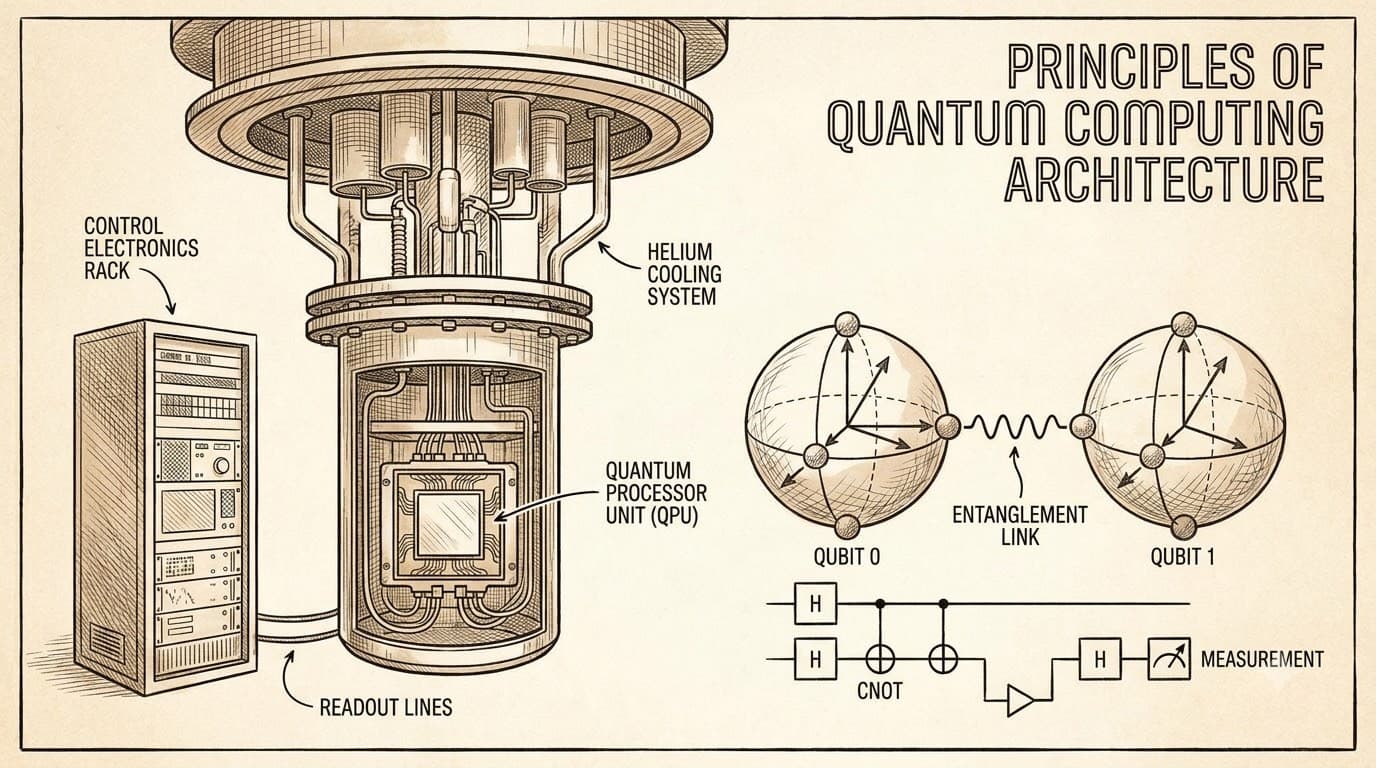

Table of Contents
Quantum computing is a topic that often feels more like science fiction than practical technology. With talk of qubits, entanglement, and superposition, it’s easy for software engineers steeped in classical computing paradigms to feel overwhelmed. However, as quantum technology matures, it is moving from the realm of theoretical physics into the hands of developers. This post aims to demystify quantum computing, providing a pragmatic understanding for those looking to grasp its potential and implications.
The Limits of Classical Computing
To appreciate quantum computing, we first need to understand the limitations of our current systems. Classical computers—from the smartphone in your pocket to the largest supercomputers—operate on a binary system. Data is stored and processed as bits, which exist in one of two states: 0 or 1.
While classical computers are incredibly powerful, there are certain types of problems that they struggle to solve efficiently. These are often complex optimization problems or simulations of molecular structures where the number of possible variables and interactions grows exponentially. For a classical computer, evaluating every possible combination sequentially would take longer than the age of the universe.
Enter the Qubit: Superposition and Entanglement
Quantum computing tackles these complex problems using a fundamentally different approach, leveraging the principles of quantum mechanics. The core unit of information in a quantum computer is the quantum bit, or qubit.
Superposition: The Power of "And"
Unlike a classical bit, which must be either a 0 or a 1, a qubit can exist in a state of superposition. This means it can represent a 0, a 1, or any combination of both simultaneously until it is measured.
Think of a spinning coin. While it’s spinning, it isn’t just heads or tails; it’s a blur of both. Only when you stop the coin (measure it) does it collapse into a definite state. This ability to hold multiple states simultaneously allows a quantum computer to process vast amounts of information in parallel. For instance, two qubits can represent four states at once (00, 01, 10, 11), three qubits represent eight states, and so on. The computational power grows exponentially with each added qubit.
Entanglement: Spooky Action at a Distance
The second crucial concept is entanglement. When two qubits become entangled, their states become linked, regardless of the physical distance between them. Measuring the state of one entangled qubit instantaneously determines the state of the other.
In classical computing, changing one bit has no immediate effect on another unrelated bit. In quantum computing, entanglement allows qubits to work together in a highly coordinated manner. This interconnectedness is what enables quantum algorithms to find solutions to complex problems much faster than classical algorithms.
What is Quantum Computing Good For?
It’s important to clarify that quantum computers are not going to replace classical computers for everyday tasks. You won't be checking your email or browsing the web on a quantum device. Instead, they are specialized tools designed for specific types of computationally intractable problems.
1. Cryptography and Security
One of the most well-known implications of quantum computing is its potential to break current encryption standards, such as RSA. Quantum algorithms, like Shor's algorithm, can factor large prime numbers exponentially faster than classical computers, rendering many modern cryptographic protocols obsolete. This has spurred the development of "post-quantum cryptography"—new encryption methods designed to be secure against quantum attacks.
2. Drug Discovery and Materials Science
Simulating the behavior of molecules and chemical reactions is incredibly complex for classical computers because they must account for the quantum interactions of every electron. Quantum computers, operating on the same quantum principles as the molecules themselves, are naturally suited for these simulations. This could revolutionize drug discovery, allowing researchers to accurately model molecular interactions and design new life-saving medications in a fraction of the time.
3. Optimization and Logistics
Many real-world problems involve finding the most efficient solution among millions of possibilities. Think of optimizing delivery routes for a massive logistics network, managing risk in financial portfolios, or minimizing energy consumption in a power grid. Quantum algorithms can evaluate multiple optimization pathways simultaneously, potentially finding optimal solutions that would elude classical systems.
The Current State of the Art: Noisy Intermediate-Scale Quantum (NISQ)
We are currently in the NISQ era of quantum computing. "Intermediate-Scale" refers to the fact that today's quantum computers have anywhere from a few dozen to a few hundred qubits—enough to demonstrate "quantum advantage" in highly specific, contrived scenarios, but not enough for broad commercial application.
"Noisy" refers to the fragility of qubits. They are highly susceptible to environmental interference (heat, electromagnetic radiation), which causes them to lose their quantum state—a process known as decoherence. Managing this noise and developing effective error-correction techniques is one of the biggest challenges facing the field today.
Getting Started: The Pragmatic Approach
You don't need a PhD in physics to start experimenting with quantum computing. Major tech companies offer cloud-based access to real quantum hardware and simulators. Frameworks like Qiskit (IBM) and Cirq (Google) provide Python-based SDKs that allow you to build and run quantum circuits.
As a software engineer, the best way to prepare for the quantum future is to start learning the new programming paradigms. Understand the difference between a classical logic gate and a quantum gate. Experiment with simple algorithms like Grover's search or quantum teleportation on a simulator.
Conclusion
Quantum computing is a paradigm shift, offering a new way to process information that could solve some of humanity's most complex challenges. While we are still years away from fault-tolerant, commercial-scale quantum computers, the foundation is being laid today. By approaching the topic pragmatically, software engineers can demystify the technology, understand its potential applications, and prepare for a future where classical and quantum systems work in tandem.
You Might Also Like
Free In-Browser Developer Tools
Clean AI CLI logs, build cron expressions, decode JWTs, and calculate chmod permissions offline.
Related Articles
Generative Engine Optimization (GEO) for Technical Docs
With traditional SEO waning, this post covers how to structure developer documentation and engineering blogs so they are prioritized and cited by AI search engines — including llms.txt, schema markup, structured code examples, and citation-worthy writing patterns.
Read more
Serverless Analytics Warehouse with BigQuery & Cloud Run: From GA4 Streams to Automated SEO Alerts
How to build an automated serverless analytics warehouse with BigQuery, Google Analytics 4, and Cloud Run: schema modeling, scheduled SQL transformations, zero-idle cost, and automated SEO query alerts.
Read more
Kubernetes HPA with Custom Metrics: Practical Autoscaling with Prometheus
Comprehensive guide covering kubernetes hpa with custom metrics: practical autoscaling with prometheus with battle-tested production examples.
Read more