WebAssembly in 2026: The Universal Runtime
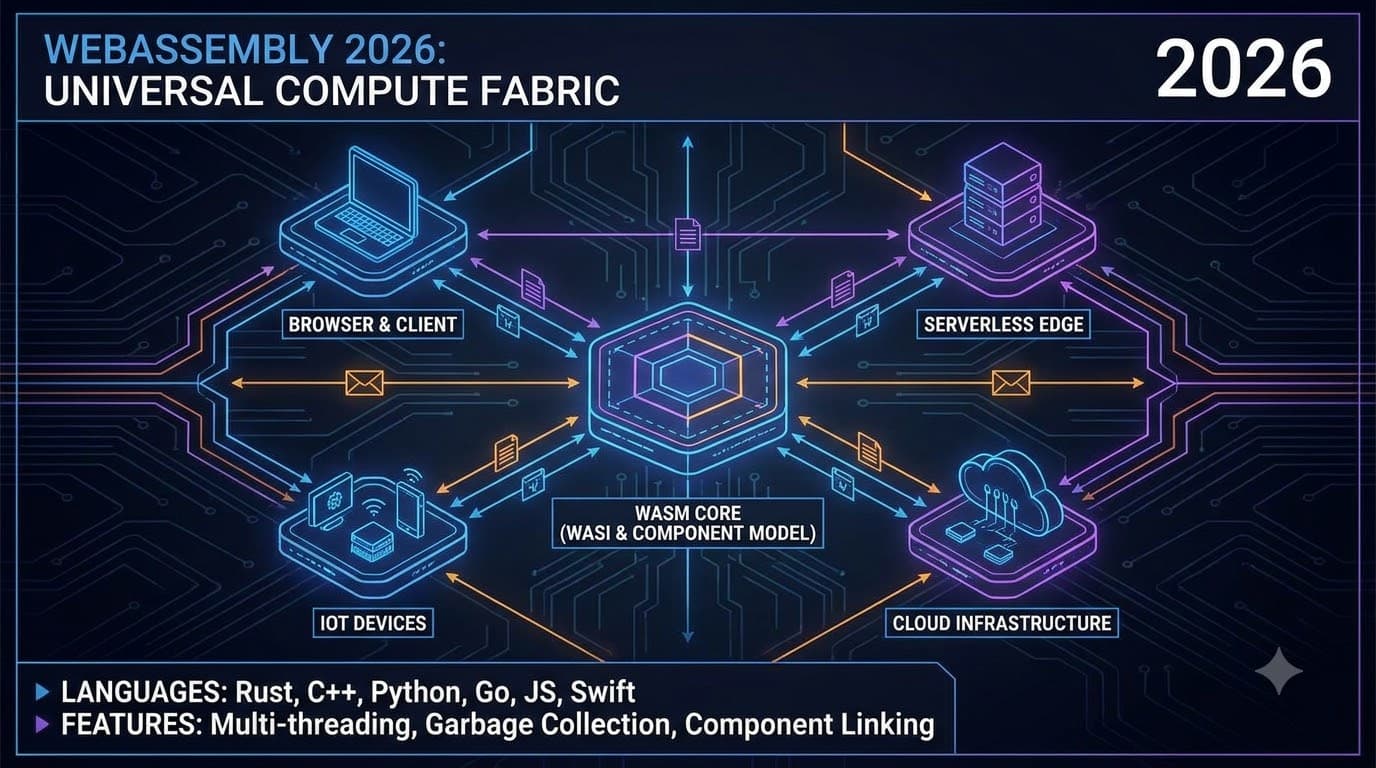

In the few short years since its inception, WebAssembly (Wasm) has evolved from a niche optimization tool for web games into a foundational pillar of modern computing. As we navigate through 2026, WebAssembly has transcended the browser, becoming the universal runtime across cloud, edge, and embedded devices. This transformation didn't happen overnight; it is the result of key innovations, standardization efforts, and a profound shift in how developers conceptualize software portability, security, and performance.
The Journey Beyond the Browser
When WebAssembly first emerged, it was hailed as the savior of web performance. It allowed developers to run code written in languages like C++, Rust, and Go within the browser at near-native speeds. It was the missing link for compute-heavy applications—video editing, 3D rendering, and complex simulations could finally break free from the performance constraints of JavaScript. However, the visionaries behind Wasm always intended for it to be more than just a browser technology.
The introduction of the WebAssembly System Interface (WASI) was the catalyst that propelled Wasm beyond the confines of the web. By providing a standardized API for accessing system resources like files, networks, and environment variables, WASI transformed WebAssembly into a viable environment for server-side and standalone execution. In 2026, WASI has matured into a robust, modular system, enabling developers to write code once and run it anywhere with unprecedented security and isolation.
The Cloud-Native Revolution
One of the most significant impacts of WebAssembly in 2026 is its dominance in the cloud-native ecosystem. Traditional containerization technologies like Docker have long been the standard for deploying applications. However, containers come with overhead—they require a full operating system environment, which consumes memory and increases startup times. WebAssembly offers a lighter, faster, and more secure alternative.
Wasm modules are incredibly lightweight, often measuring only a few kilobytes. This allows them to start in milliseconds, making them ideal for serverless computing and edge deployments. Major cloud providers have deeply integrated WebAssembly into their infrastructure, offering native Wasm runtimes that execute user code with near-instantaneous scaling. The "cold start" problem, a long-standing issue in serverless architectures, is virtually non-existent with WebAssembly.
Furthermore, the Wasm component model has revolutionized how microservices are built. Instead of deploying separate containers that communicate over network protocols, developers can compose applications from smaller, interoperable Wasm components. These components can be written in different languages but communicate securely and efficiently within the same runtime environment, drastically reducing latency and simplifying deployment pipelines.
Security and Isolation: A New Paradigm
In an era where cybersecurity threats are increasingly sophisticated, WebAssembly's fundamentally secure architecture is a massive advantage. Wasm operates within a strict sandboxed environment. By default, a Wasm module has no access to the host operating system, network, or filesystem. All external interactions must be explicitly granted through capability-based security models.
In 2026, this default-deny approach is the gold standard for secure software execution. It mitigates entire classes of vulnerabilities, such as buffer overflows and unauthorized resource access. Enterprises are migrating their legacy, security-critical applications to WebAssembly precisely to leverage this isolation. Even if a Wasm module is compromised, the attacker is trapped within the sandbox, unable to pivot to the host system or other modules.
This level of security is particularly crucial at the edge, where code is executed on distributed, potentially untrusted nodes. WebAssembly ensures that edge compute workloads run safely without compromising the integrity of the host device or exposing sensitive data.
The Developer Experience and Ecosystem
The developer experience around WebAssembly has matured dramatically by 2026. Initially, compiling to Wasm was a complex process fraught with limitations, particularly regarding garbage collection and threading. Today, those hurdles have been largely overcome.
The addition of native garbage collection support in WebAssembly has opened the floodgates for a broader range of languages. Languages like Java, Kotlin, C#, and even Python can now compile to Wasm efficiently, without the need to bundle a heavy runtime environment. This has democratized WebAssembly, making it accessible to millions of developers who previously found it out of reach.
Tooling has also seen a massive leap forward. Integrated Development Environments (IDEs) offer seamless Wasm debugging, profiling, and testing. Package managers specific to WebAssembly components have emerged, allowing developers to easily discover, share, and reuse pre-compiled Wasm modules. The ecosystem is vibrant and self-sustaining, driven by a community that recognizes the value of portable, secure, and performant code.
Looking Ahead: The Ubiquitous Runtime
As we look toward the end of the decade, the trajectory of WebAssembly is clear: it is becoming the ubiquitous runtime for software execution. From smart home IoT devices running lightweight Wasm modules to massive cloud infrastructure processing terabytes of data, WebAssembly's footprint is everywhere.
The dream of "write once, run anywhere," first promised by Java decades ago, is finally being realized in a truly language-agnostic, secure, and high-performance manner. WebAssembly in 2026 is no longer just a fascinating technology to watch; it is the bedrock upon which the next generation of software is being built.
You Might Also Like
Free In-Browser Developer Tools
Clean AI CLI logs, build cron expressions, decode JWTs, and calculate chmod permissions offline.
Related Articles

WebAssembly (Wasm) Beyond the Browser: A New Era of Compute
How WebAssembly is revolutionizing serverless computing: Wasmtime, WASI 0.2 components, sub-millisecond cold starts, and container replacement patterns.
Read more
Rust for Frontend Developers: A Practical Transition Guide
Why frontend developers are increasingly adopting Rust for tooling and WebAssembly, and how you can transition your mental model from JavaScript/TypeScript.
Read more
Why WebAssembly is the Future of Edge Computing
Discover how WebAssembly (Wasm) is revolutionizing the edge computing landscape, bringing near-instant cold starts, exceptional performance, and robust security to serverless applications.
Read more