AI Agents Architecture: Building Autonomous Systems
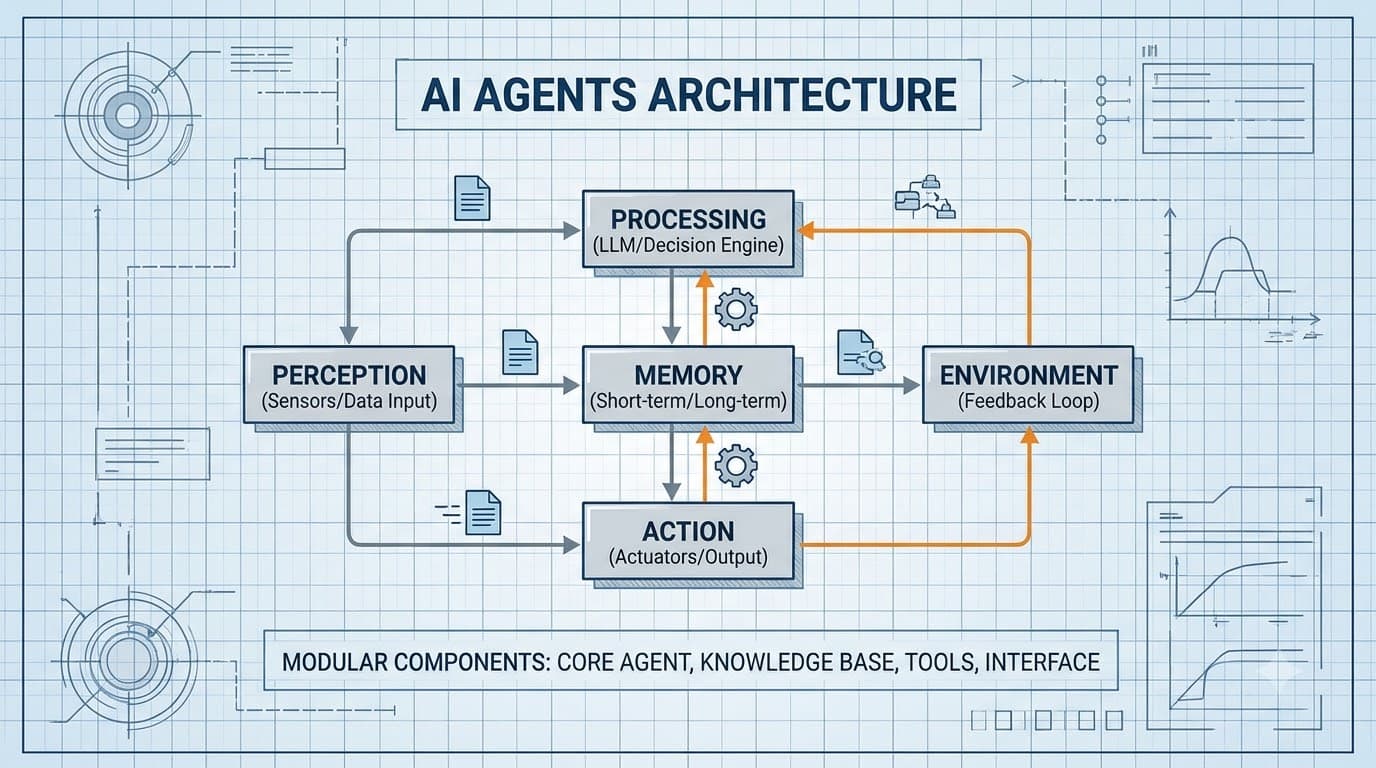

The landscape of artificial intelligence has shifted dramatically over the past few years. In 2026, the focus is no longer simply on training massive language models to answer questions or generate text. Instead, the industry has fully pivoted towards building autonomous AI agents—systems capable of perceiving their environment, reasoning about complex goals, planning multi-step actions, and executing those plans with minimal human intervention. This evolution represents a fundamental change in how we interact with technology and how software is architected.
The Anatomy of an AI Agent
At its core, an autonomous AI agent is more than just a prompt wrapped around a large language model (LLM). It is a complex software system comprised of several distinct architectural components working in concert. These components typically include a perception layer, a cognitive engine (often powered by an LLM), a memory system, and an action or tool-use layer.
1. Perception and Context Processing
An agent must first understand its environment and the task at hand. The perception layer handles the intake of multimodal data—text, images, audio, and structured data like JSON or API responses. In 2026, agents are designed to process massive context windows natively, allowing them to ingest entire codebases, extensive documentation, or prolonged conversation histories instantly. This layer is responsible for filtering noise and highlighting the salient information required for decision-making.
2. The Cognitive Engine: Reasoning and Planning
The cognitive engine is the brain of the agent. While earlier iterations relied on simple zero-shot prompting, modern agent architectures employ sophisticated reasoning frameworks. Techniques like Chain-of-Thought (CoT), ReAct (Reasoning and Acting), and Tree of Thoughts (ToT) are now deeply integrated into the agent's core loop.
When presented with a high-level goal, the cognitive engine breaks it down into a sequence of actionable steps. This planning phase is crucial. The agent must anticipate dependencies, handle potential roadblocks, and formulate contingency plans. Furthermore, modern engines are capable of self-reflection and self-correction. If a step fails, the agent doesn't simply crash; it analyzes the error, adjusts its strategy, and tries an alternative approach.
3. Memory: Short-Term and Long-Term
A key differentiator between a simple chatbot and an autonomous agent is memory. Agent architectures in 2026 utilize dual memory systems.
Short-term memory manages the context of the current task or conversation. It tracks the immediate state of execution, recent tool outputs, and the current step in the plan. This is typically handled within the context window of the underlying model.
Long-term memory, however, is what enables agents to learn and adapt over time. Utilizing vector databases and semantic search, agents can store and retrieve information from past interactions, successful problem-solving strategies, and user preferences. This persistent memory allows an agent to build a comprehensive understanding of a specific project or domain, making it increasingly effective the longer it is deployed.
4. The Action Layer: Tool Use and Integration
An agent's ability to reason is useless if it cannot interact with the world. The action layer equips the agent with tools—APIs, command-line interfaces, web browsers, and code execution environments. In 2026, the standardization of tool-calling protocols has made it trivial to plug new capabilities into an agent.
Agents can now write, compile, and test code, query databases, manage cloud infrastructure, and communicate with other agents. This layer must be designed with strict security constraints, often employing containerized environments or sandboxes to ensure that the agent's actions cannot cause unintended harm or expose sensitive data.
Multi-Agent Systems and Collaboration
Perhaps the most exciting development in 2026 is the rise of multi-agent systems. Complex tasks are rarely handled by a single monolithic agent. Instead, we see swarms of specialized agents collaborating towards a common goal.
In a software development scenario, you might have a 'Product Manager' agent that translates user requirements into technical specifications. A 'Developer' agent writes the code, while a 'QA' agent simultaneously writes and executes tests. A 'DevOps' agent manages the deployment pipeline. These agents communicate asynchronously, debating approaches, reviewing each other's work, and iterating until the software is robust.
This collaborative architecture mimics human organizations but operates at machine speed. It requires sophisticated orchestration frameworks to manage inter-agent communication, resolve conflicts, and maintain global state, leading to the creation of entirely new classes of middleware designed specifically for agent swarms.
Challenges and The Future
Despite the rapid advancements, building reliable AI agents is not without challenges. Ensuring determinism and predictability remains a significant hurdle. When you give a system autonomy, the surface area for unexpected behavior grows exponentially. Rigorous testing frameworks and bounded execution constraints are essential to prevent agents from spiraling into infinite loops or making catastrophic errors.
Furthermore, as agents become more capable, questions of governance, ethics, and accountability come to the forefront. Determining who is responsible for the actions of an autonomous agent is a complex legal and philosophical issue that society is only just beginning to grapple with.
As we look beyond 2026, the architecture of AI agents will continue to mature. We are moving towards a future where software is not just a static set of instructions, but a dynamic, reasoning entity capable of understanding our goals and working alongside us to achieve them. The era of autonomous systems is here, and it is reshaping the foundation of software engineering.
You Might Also Like
Free In-Browser Developer Tools
Clean AI CLI logs, build cron expressions, decode JWTs, and calculate chmod permissions offline.
Related Articles

Vector Databases for Production RAG (2026): Pinecone vs Qdrant vs Milvus vs pgvector
An architectural benchmark of Pinecone, Qdrant, Milvus, and pgvector for production RAG pipelines: HNSW vs IVFFlat indexing, single-stage filtered search, p95 latency, and memory footprint.
Read more
Understanding Retrieval-Augmented Generation (RAG)
A deep dive into Retrieval-Augmented Generation (RAG): chunking strategies, vector embeddings, hybrid dense-sparse search, and reranking pipelines.
Read more
Rethinking Risk in the Age of AI
What I've learned building fraud detection systems with AI after years of rules-based approaches: where ML actually helps, where it doesn't, and what deploying a model in production taught me.
Read more