WebAssembly in 2026: Beyond the Browser


When WebAssembly (Wasm) was first announced, it was hailed as the technology that would finally break JavaScript's monopoly on the browser. It allowed developers to compile C++, Rust, and Go into a binary format that ran at near-native speeds on the web.
However, as we look at the landscape in 2026, Wasm's most profound impact hasn't been in the browser; it has been in the cloud. WebAssembly has evolved from a web technology into a universal, secure, and incredibly fast compute runtime.
This post explores the "Wasm-everywhere" revolution and how it is reshaping backend architecture, edge computing, and plugin systems.
The Core Value Proposition: Security and Speed
Why are companies adopting Wasm on the backend when Docker containers already exist? The answer lies in the fundamental differences in architecture.
A Docker container contains a full Linux filesystem and OS user-space. Starting a container takes seconds, and they require hundreds of megabytes of memory. Furthermore, containers rely on Linux namespaces and cgroups for security, which have historically been vulnerable to container-escape exploits.
A WebAssembly module, conversely, contains only the compiled application logic.
- Speed: A Wasm runtime (like Wasmtime or Wasmer) can instantiate and execute a module in microseconds (sub-millisecond startup times).
- Security: Wasm operates in a strict, deny-by-default sandbox. A Wasm module cannot access the host filesystem, network, or environment variables unless explicitly granted permission by the host runtime.
This combination of microsecond startups and bulletproof sandboxing makes Wasm the perfect technology for multi-tenant environments.
WASI: The Missing Link
Wasm originally had no way to interact with the outside world. It was a pure computation engine.
To run on a server, it needed standard system interfaces (like reading files or opening network sockets). This led to the creation of WASI (The WebAssembly System Interface).
WASI defines a standardized API for system calls. When you compile a Rust program to wasm32-wasi, the resulting binary can run on any operating system or architecture (Windows, macOS, Linux, ARM, x86) provided it has a WASI-compliant runtime installed. It fulfills the original promise of Java ("Write Once, Run Anywhere") without the overhead of a massive JVM.
Key Use Cases in 2026
1. The Next Generation of Serverless
Traditional serverless functions (like AWS Lambda) suffer from cold starts due to the container initialization overhead.
Platform providers are now replacing container-based serverless with Wasm-based execution environments (e.g., Fermyon Spin, Cloudflare Workers). Because a Wasm module boots in microseconds, the concept of a "cold start" effectively disappears. Providers can pack tens of thousands of idle Wasm modules onto a single server, achieving unprecedented density and cost savings.
2. Extensible Plugin Systems
Historically, if you wanted users to write plugins for your SaaS product, you had two bad options:
- Force them to use a specific scripting language (like Lua or a subset of JavaScript).
- Have them build and host an external webhook API.
With Wasm, you can allow users to write plugins in any language that compiles to Wasm (Rust, Go, Python, TypeScript). You compile their code into a .wasm file, and your application embeds a lightweight Wasm runtime.
When an event occurs in your app, you execute their Wasm module in a secure sandbox. Even if the user writes malicious code, it cannot crash your main process or steal data from other tenants. Tools like Extism have made embedding these runtimes trivial.
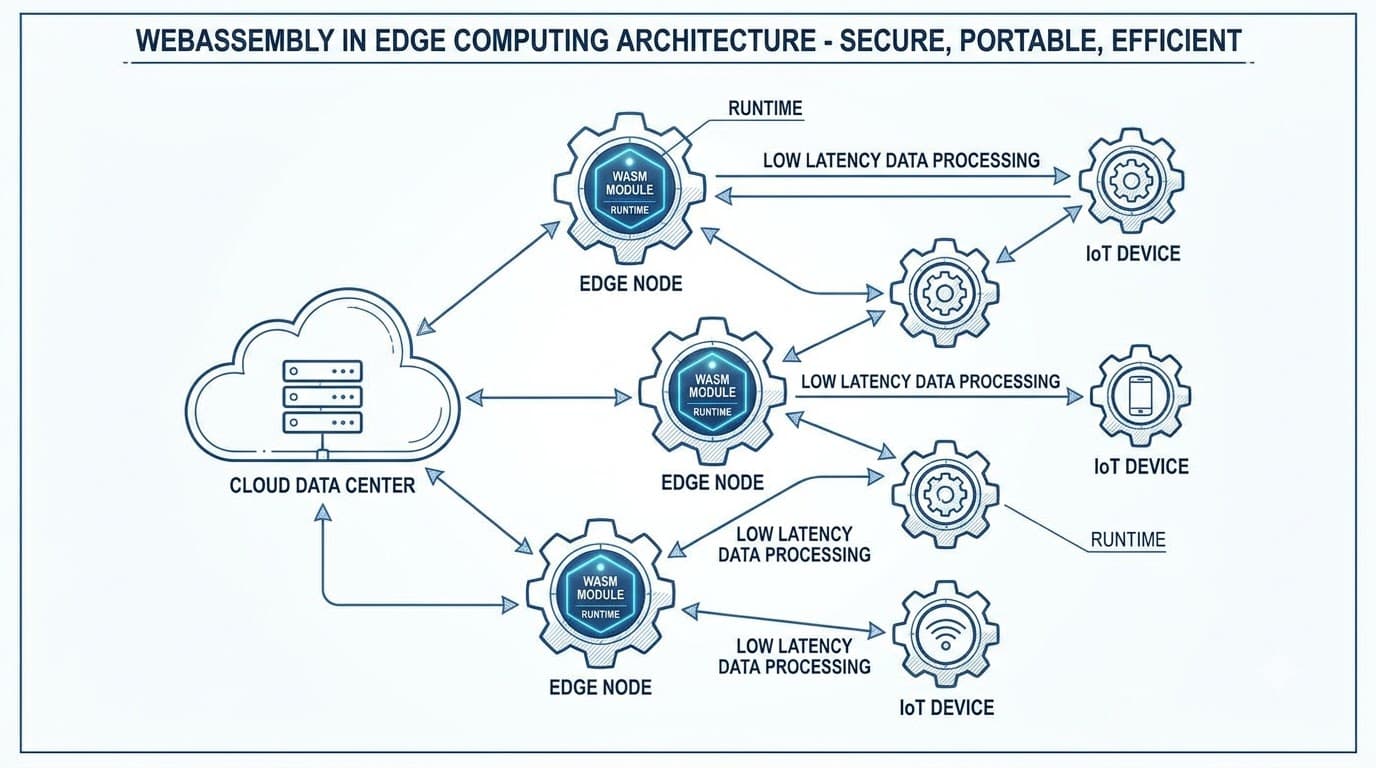
3. Edge Computing and IoT
IoT devices (smart thermostats, industrial sensors) have very limited CPU and memory. Running a full Linux OS or a heavy Node.js runtime is often impossible.
Wasm's incredibly small footprint makes it ideal for the Edge and IoT. You can deploy identical, secure Wasm binaries to heavy cloud servers and tiny ARM-based edge devices without modification.
The Component Model
The final piece of the Wasm puzzle arriving in the mainstream is the WebAssembly Component Model.
Historically, Wasm modules couldn't easily talk to each other if they were written in different languages, as they only understood numbers and pointers. The Component Model provides a high-level ABI (Application Binary Interface), allowing a Wasm module written in Rust to seamlessly pass complex data types (like strings or JSON objects) to a Wasm module written in Python.
This allows developers to build applications by snapping together polyglot Wasm components like Lego bricks, fostering a massive ecosystem of reusable, secure compute units.
Conclusion
WebAssembly has entirely outgrown its name. It is no longer just for the Web, and it isn't an Assembly language. It is a secure, incredibly fast, and portable compilation target that is actively displacing older container technologies in environments where startup speed, security, and portability are paramount. The future of cloud computing is binary, and it is shaped like Wasm.
You Might Also Like
Free In-Browser Developer Tools
Clean AI CLI logs, build cron expressions, decode JWTs, and calculate chmod permissions offline.
Related Articles
The Future of WebAssembly in Edge Computing: Architecture, WASI 0.2, and Benchmarks
Exploring how WebAssembly (Wasm) and WASI 0.2 are redefining edge computing with microsecond cold starts, capability-based security, and Rust components.
Read more
Rust for Frontend Developers: A Practical Transition Guide
Why frontend developers are increasingly adopting Rust for tooling and WebAssembly, and how you can transition your mental model from JavaScript/TypeScript.
Read more
WebAssembly (Wasm) Beyond the Browser: A New Era of Compute
How WebAssembly is revolutionizing serverless computing: Wasmtime, WASI 0.2 components, sub-millisecond cold starts, and container replacement patterns.
Read more