Serverless vs Edge Computing


Table of Contents
- Architectural Comparison: Centralized Serverless vs Edge Isolate
- Runtime Internals: MicroVMs vs V8 Isolates
- Centralized Serverless (Container Sandboxing)
- Distributed Edge (V8 Isolate Sandboxing)
- The Data Gravity Dilemma: Why Edge Can Slow Down Your App
- Solving Edge Data Gravity in 2026
- Cost Analysis: Requests vs Compute Duration
- Edge Pricing (Cloudflare Workers, Fastly)
- Serverless Pricing (AWS Lambda)
- Decision Matrix: Choosing the Right Runtime
- Frequently Asked Questions
- Can Edge computing completely replace AWS Lambda?
- How do Edge functions achieve near-zero cold starts?
- Does Vercel use Edge or Serverless by default?
- You Might Also Like
Modern cloud engineering often treats "Serverless" and "Edge Computing" as interchangeable buzzwords. Both promise zero server provisioning, elastic auto-scaling from zero to thousands of concurrent requests, and pay-per-execution billing. However, beneath the marketing layer lies a fundamental architectural divergence that dictates application performance, database latency, and operational cost.
Deploying compute without understanding the physical reality of packet travel and runtime sandboxing can inadvertently quadruple user latency. This guide breaks down the core technical differences between centralized serverless containers and distributed edge isolates, examining cold starts, runtime constraints, data gravity, and production decision trees.
Architectural Comparison: Centralized Serverless vs Edge Isolate
Traditional serverless (such as AWS Lambda, Google Cloud Functions, or Azure Functions) executes code inside container-like lightweight virtual machines (e.g., AWS Firecracker MicroVMs) provisioned in centralized data center regions (like us-east-1 or eu-central-1).
Edge computing (such as Cloudflare Workers, Fastly Compute, or Vercel Edge Middleware) shifts code execution to Point-of-Presence (PoP) edge servers distributed globally across hundreds of metropolitan access points.
| Architectural Dimension | Centralized Serverless (e.g., AWS Lambda) | Distributed Edge (e.g., Cloudflare Workers) |
|---|---|---|
| Physical Location | Centralized availability zones (us-east-1) | 300+ Anycast PoPs worldwide |
| Sandboxing Technology | MicroVMs / Linux Containers (Firecracker) | V8 Isolates or WebAssembly (Wasm) |
| Cold Start Latency | 150ms – 1,200ms (Container init & VPC attach) | 2ms – 10ms (Isolate instantiate) |
| Execution Ceiling | Up to 15 minutes | 30s – 50ms CPU wall time |
| Memory Allocation | 128 MB to 10 GB | 128 MB default (up to 512 MB paid) |
| Filesystem Access | Ephemeral /tmp storage (up to 10 GB) | Stateless (No writable local filesystem) |
| Network Proximity | Close to centralized RDS/Aurora databases | Close to the end-user (last-mile CDN) |
Runtime Internals: MicroVMs vs V8 Isolates
The fundamental difference between centralized serverless and edge computing lies in their isolation primitives.
Centralized Serverless (Container Sandboxing)
AWS Lambda creates a dedicated Linux cgroup and namespace using the Firecracker MicroVM. When a cold request lands:
- The cloud orchestrator allocates host hardware.
- A lightweight Linux kernel boots (~100ms).
- The Node.js, Python, or Go runtime initializes (~80ms).
- Application dependencies are loaded and evaluated (~150ms+).
- The handler processes the event.
While AWS SnapStart and provisioned concurrency mitigate this, cold starts remain a persistent factor in centralized serverless architectures.
// AWS Lambda (Node.js 20 ESM) - Centralized Serverless
// Capable of heavy computation, npm native modules, and long-running batch jobs
import { S3Client, GetObjectCommand } from '@aws-sdk/client-s3';

const s3 = new S3Client({ region: 'us-east-1' });

export const handler = async (event: any) => {
  const startTime = performance.now();

  // Full access to Node.js ecosystem, file system, and 15-minute runtime ceiling
  const data = await s3.send(new GetObjectCommand({
    Bucket: process.env.DATA_BUCKET,
    Key: event.recordId,
  }));

  return {
    statusCode: 200,
    headers: { 'Content-Type': 'application/json' },
    body: JSON.stringify({
      processedInMs: performance.now() - startTime,
      status: 'success',
    }),
  };
};
Distributed Edge (V8 Isolate Sandboxing)
Edge runtimes dispense with operating system virtualization entirely. Instead of booting an OS, they run a single multi-tenant process running Google's V8 engine (the same JavaScript engine inside Chromium).
Each customer function runs inside an Isolate—an independent execution thread with its own heap and global scope. Creating an isolate requires creating a memory context rather than booting a process, slashing cold boot overhead from 300ms down to sub-5ms.
// Cloudflare Worker / Vercel Edge - Lightweight Edge Runtime
// Zero-millisecond startup, standards-compliant Web APIs (fetch, Request, Response)
export default {
  async fetch(request: Request, env: Env): Promise<Response> {
    const url = new URL(request.url);

    // Geolocation data injected directly from the Edge TCP handshake
    const country = request.headers.get('cf-ipcountry') || 'US';
    const city = request.headers.get('cf-ipcity') || 'Unknown';

    // Fast header manipulation or edge key-value lookup
    if (url.pathname === '/api/geo-context') {
      return new Response(JSON.stringify({ country, city, edgePop: env.POP_ID }), {
        status: 200,
        headers: {
          'Content-Type': 'application/json',
          'Cache-Control': 'public, s-maxage=3600',
        },
      });
    }

    // Dynamic origin routing with zero origin cold-start latency
    return fetch(request);
  },
};
The Data Gravity Dilemma: Why Edge Can Slow Down Your App
A common anti-pattern in modern full-stack development is deploying API routes to the Edge while keeping the relational database (Postgres, MySQL) in a single centralized region like us-east-1 (N. Virginia).
Consider a user in Tokyo requesting data from an application whose Edge Function executes in Tokyo, but queries an Aurora PostgreSQL cluster in Virginia:
[User: Tokyo]
     │ (5ms)
     ▼
[Edge Worker: Tokyo]
     │ (150ms TCP + TLS handshake across Pacific)
     │ (150ms Query 1: Auth check)
     │ (150ms Query 2: Fetch user record)
     │ (150ms Query 3: Fetch preferences)
     ▼
[Postgres: us-east-1]
Because the Edge Function in Tokyo is executing synchronous sequential network round-trips over the trans-Pacific fiber line, total page load time explodes to 600ms+.
In contrast, if the API function had run as a centralized serverless function in us-east-1:
- User in Tokyo sends request to
us-east-1(150ms trans-Pacific transit). - Lambda in
us-east-1executes all 3 database queries over local VPC fibers (< 1ms each = 3ms total). - Result returned to Tokyo (150ms return transit).
- Total latency: 303ms (half the latency of the naive Edge implementation!).
Rule of Thumb:
Do not put compute at the edge unless the data it queries is also at the edge.
Solving Edge Data Gravity in 2026
To run compute effectively at the edge, data architecture must align with one of three paradigms:
- Edge-Native Replicated KV/Stores: Cloudflare KV, D1 (distributed SQLite), or Upstash Redis with global read-replicas.
- Read-Heavy Caching Layer: Cache authenticated session tokens or tenant config at the edge, only proxying uncached mutations to the origin.
- Stateless Operations: A/B testing, JWT signature validation, bot mitigation, and geo-targeted URL rewrites.
Cost Analysis: Requests vs Compute Duration
Pricing models diverge significantly between centralized serverless and edge providers:
Edge Pricing (Cloudflare Workers, Fastly)
- Typically charges per million requests (0.15 to 0.50 per 1M requests).
- Extremely cost-effective for high-volume, low-CPU tasks (e.g., static asset routing, auth gatekeeping, URL redirects).
- Example: 100 million requests completing in 5ms CPU time costs ~$50/month.
Serverless Pricing (AWS Lambda)
- Charges for GB-seconds (Memory allocated \times Execution Duration) plus request count ($0.20 per 1M requests).
- Ideal for complex tasks requiring 2–4 GB of memory, heavy image processing (sharp/libvips), PDF generation (headless Chromium), or long database aggregations.
- Example: Running long-running background workers on Edge is impossible due to the 30-second execution cutoff, making Lambda the correct financial and architectural choice.
Decision Matrix: Choosing the Right Runtime
| Workload Requirement | Optimal Runtime | Rationale |
|---|---|---|
| Authentication & JWT Verification | Edge | Validates cryptographic signatures in 1ms before traffic ever reaches upstream servers. |
| Dynamic A/B Testing & Geo-Routing | Edge | Rewrites URLs without origin roundtrips; reads geo headers natively. |
| Relational DB CRUD (Prisma, Drizzle + RDS) | Centralized Serverless | Co-locates compute in the same AWS VPC as Postgres to eliminate network roundtrips. |
| Heavy File/Image Processing | Centralized Serverless | Needs local /tmp disk, native binaries (FFmpeg, Sharp), and higher memory ceilings. |
| AI Model Inference (Small ONNX / Embeddings) | Edge | Edge AI (Cloudflare Workers AI) enables ultra-low latency prompt tokenization. |
| AI Agent Long-Running Tool Loops | Centralized Serverless | Agent orchestration often exceeds 30 seconds, demanding 5–15 minute execution windows. |
Frequently Asked Questions
Can Edge computing completely replace AWS Lambda?
No. Edge compute excels at stateless, low-latency, and fast-terminating workloads (< 50ms CPU time). Centralized serverless remains indispensable for long-running workflows, heavy background processing, large in-memory caching, VPC private networking, and compute-heavy containerized workloads.
How do Edge functions achieve near-zero cold starts?
Edge platforms use V8 isolates rather than container virtualization. Instead of starting an operating system kernel and importing heavy node module dependencies, V8 isolates initialize a new V8 JavaScript memory heap inside a running daemon in under 5 milliseconds.
Does Vercel use Edge or Serverless by default?
Vercel App Router uses Centralized Node.js Serverless Functions (nodejs runtime) by default. You must explicitly specify export const runtime = 'edge' in your page or route handler to deploy to the Edge network.
You Might Also Like
Free In-Browser Developer Tools
Clean AI CLI logs, build cron expressions, decode JWTs, and calculate chmod permissions offline.
Related Articles
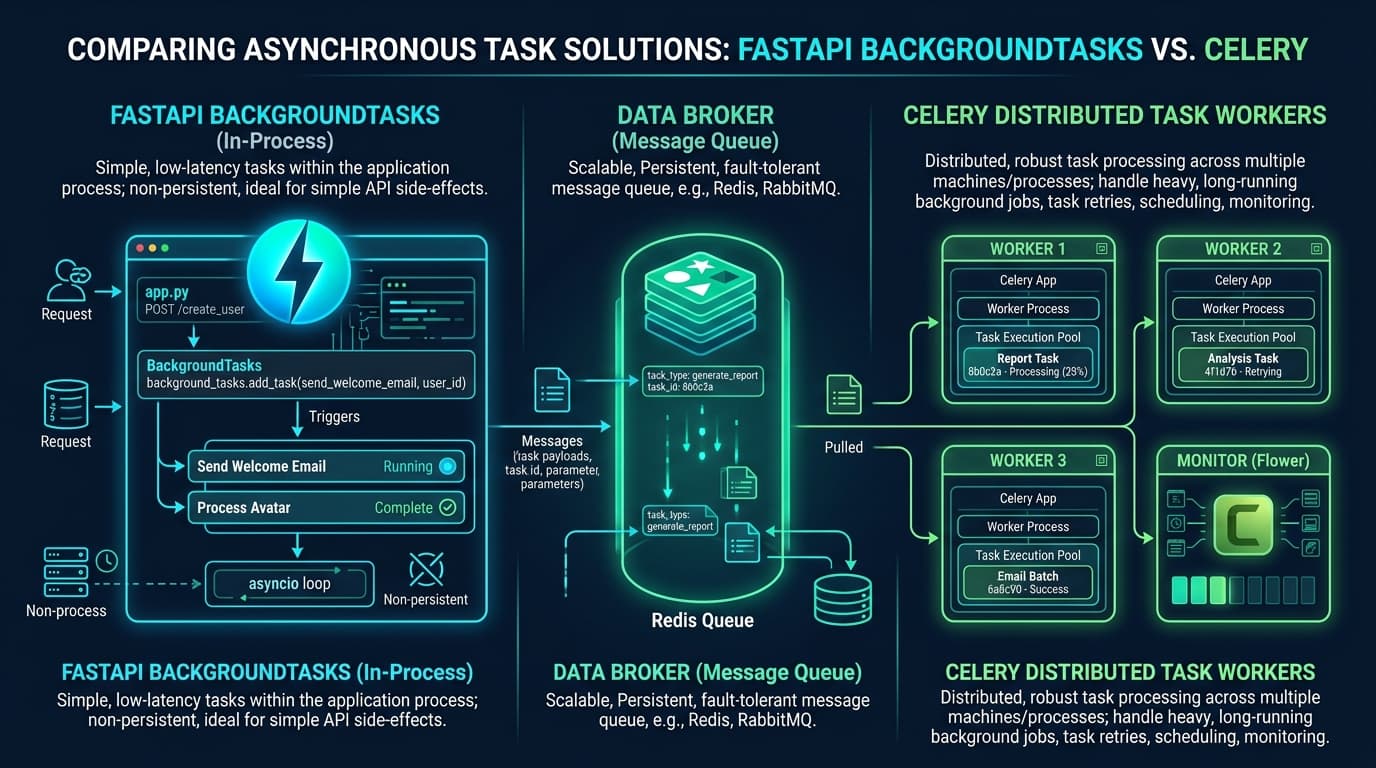
FastAPI vs Celery: When to Use BackgroundTasks vs Distributed Task Queues
FastAPI BackgroundTasks vs Celery: architectural trade-offs, event-loop blocking risks, Redis message brokers, memory benchmarks, and when to switch.
Read more
AWS Lambda Cold Starts in 2026: Mitigation Strategies
Cold starts have always been a challenge in serverless environments. Discover the most effective strategies for mitigating AWS Lambda cold starts in 2026, including SnapStart, provisioned concurrency, and language choice.
Read more
Event-Driven Architecture with Kafka
Architect resilient event-driven systems using Apache Kafka: master partition keying, consumer group rebalancing, and exactly-once processing semantics.
Read more