The Hidden Pitfalls of Serverless Architecture


Table of Contents
- 1. The Real Cost of Cold Starts: Physics vs Promises
- Production Mitigation Strategies
- 2. The Database Connection Pooling Nightmare
- The Fix: Connection Multiplexing & HTTP Data APIs
- 3. The Recursive Billing Storm: The Infinite Loop Trap
- Real-World Failure Scenario
- Essential Circuit Breaker Defenses
- 4. Architectural Complexity: The "Lambda-Pin" Anti-Pattern
- The Modern Compromise: The "Lambda-lith"
- Serverless vs Containers: Decision Matrix
- Frequently Asked Questions
- Conclusion
- You Might Also Like
Serverless computing—pioneered by AWS Lambda, Google Cloud Functions, and Cloudflare Workers—promises an engineering utopia: zero operating system administration, infinite hands-free scalability, and a payment model that scales strictly to zero when traffic subsides.
For event-driven asynchronous processing and sporadic webhook handling, serverless is transformative.
However, as thousands of engineering teams have migrated enterprise workloads to serverless over the past decade, many have encountered a complex array of architectural pitfalls that vendor marketing brochures rarely mention.
From catastrophic connection pool storms on relational databases to recursive billing loops that drain company budgets overnight, this guide explores the realities of operating serverless architectures in 2026 and provides battle-tested patterns to avoid them.
1. The Real Cost of Cold Starts: Physics vs Promises
When a serverless function is invoked after a period of dormancy, the cloud hypervisor must perform a sequence of initialization steps before processing a single line of user code:
- Allocate compute slice (Firecracker microVM in AWS Lambda).
- Download container or zip archive layers from S3/ECR.
- Boot the language runtime (Node.js, Python, Java JVM).
- Execute global-scope initialization logic (establishing database connections, importing heavy libraries).
This initialization penalty is the Cold Start.
[ Cold Start Sequence (500ms - 3,500ms) ]
┌─────────────────┬───────────────────┬─────────────────┬─────────────────┐
│ Firecracker VM  │ Runtime Boot      │ Global Imports  │ Handler Execute │
│ (50 - 150ms)    │ (100 - 400ms)     │ (300 - 3000ms)  │ (10 - 50ms)     │
└─────────────────┴───────────────────┴─────────────────┴─────────────────┘
While a 1.5-second cold start is acceptable for an asynchronous SQS queue worker, it introduces unacceptable tail latency (p99) on user-facing HTTP APIs.
Production Mitigation Strategies
- Keep Global Scope Minimal: Avoid importing entire SDKs (
import * as AWS from 'aws-sdk'). Import individual client modules dynamically or tree-shake dependencies during build time usingesbuild. - Adopt Compiled, Minimal Runtimes: Compiled languages like Go and Rust on AWS Lambda custom runtimes (
provided.al2023) boast cold starts under 25ms, compared to 300–800ms for Python/Node.js, and 2,000ms+ for legacy JVM runtimes. - AWS Lambda SnapStart: For Java and Python workloads, SnapStart initializes the microVM at deployment time, takes an encrypted memory snapshot, and restores execution state in sub-100ms.
- Provisioned Concurrency: Keeps a pre-allocated pool of execution environments initialized. Trade-off: Provisioned Concurrency bills continuously per hour, forfeiting the "scale-to-zero" economic advantage of serverless.
2. The Database Connection Pooling Nightmare
Traditional relational database engines (PostgreSQL, MySQL) were architected under the assumption of long-lived stateful connections. An application server pool (e.g., 4 instances of Django or Spring Boot) maintains 40 persistent TCP connections over days or weeks.
Serverless completely inverts this paradigm. Because each concurrent invocation runs in an isolated microVM, a sudden traffic spike of 2,000 concurrent requests creates 2,000 independent Lambda execution environments.
If each environment opens a connection to PostgreSQL, the database instantly receives 2,000 simultaneous TCP handshakes:
[ 2,000 Concurrent Lambdas ]
    │   │   │   │   │
    ▼   ▼   ▼   ▼   ▼   (2,000 Simultaneous TCP Connections!)
┌─────────────────────────┐
│   PostgreSQL Instance   │  --> MAX CONNECTIONS EXCEEDED (500)
│   (Max Connections: 500)│  --> CRASH / DEADLOCK / CASCADING TIMEOUTS!
└─────────────────────────┘
The database server experiences CPU exhaustion from backend process forking, exhausts available file descriptors, and crashes, taking down the entire system.
The Fix: Connection Multiplexing & HTTP Data APIs
[ 2,000 Ephemeral Lambdas ]
              │ (HTTP / Fast TCP Multiplexing)
              ▼
    ┌───────────────────┐
    │  AWS RDS Proxy /  │  --> Maintains a steady pool of 50 long-lived
    │    PgBouncer      │      database connections to Postgres
    └─────────┬─────────┘
              │ (50 Stable Connections)
              ▼
    ┌───────────────────┐
    │  PostgreSQL DB    │  --> Operates smoothly at 15% CPU load
    └───────────────────┘
- Deploy a Dedicated Connection Pooler: Place AWS RDS Proxy or PgBouncer in front of your database. The proxy holds a fixed pool of database connections and multiplexes thousands of ephemeral Lambda queries over them.
- Adopt Connectionless Serverless Databases: For native serverless workloads, transition to databases engineered for stateless HTTP transport, such as Neon (serverless Postgres with WebSocket/HTTP pooling), PlanetScale, or DynamoDB.
3. The Recursive Billing Storm: The Infinite Loop Trap
In server-based infrastructure, a logic bug that creates an infinite loop pins the server CPU to 100%. The process crashes, the monitoring system alerts, and your cloud bill remains unchanged.
In serverless environments, cloud providers automatically scale compute capacity to match invocation demand. If a recursive loop is introduced, your cloud infrastructure will scale aggressively into tens of thousands of instances:
┌─────────────────┐        1. Message Put        ┌─────────────────┐
│   S3 / DynamoDB │ ───────────────────────────> │  Lambda Handler │
└─────────────────┘                              └────────┬────────┘
         ▲                                                │
         │             2. Writes Object / Error           │
         └────────────────────────────────────────────────┘
                 (Infinite Exponential Trigger Storm!)
Real-World Failure Scenario
- An image is uploaded to an S3 bucket, triggering a Lambda thumbnail resize function.
- The Lambda function saves the resized thumbnail back into the same S3 bucket.
- The newly saved thumbnail triggers the Lambda function again.
- Within 30 minutes, 500,000 Lambdas run concurrently, generating thousands of dollars in S3 and Lambda charges.
Essential Circuit Breaker Defenses
# AWS SAM / CloudFormation Circuit Breaker
Resources:
  ImageProcessorFunction:
    Type: AWS::Serverless::Function
    Properties:
      Handler: index.handler
      Runtime: nodejs20.x
      # 1. Hard Concurrency Ceiling (Financial Circuit Breaker)
      ReservedConcurrentExecutions: 50
      # 2. Strict Timeout Protection
      Timeout: 10
- Reserved Concurrency Limits: Always specify
ReservedConcurrentExecutionson every function. This establishes an absolute ceiling on the number of concurrent executions, preventing runaway spend. - Separation of Ingress and Egress Buckets: Event triggers must never write outputs back into their source event path.
- Tiered CloudWatch Billing Alarms: Configure alarms that send SMS and PagerDuty alerts at 50%, 100%, and 200% of expected daily spend.
4. Architectural Complexity: The "Lambda-Pin" Anti-Pattern
When organizations break an application into 150 granular single-purpose functions (e.g., getUser, updateUserEmail, deleteUserCart), the complexity does not disappear—it moves into the network configuration and deployment pipelines.
- Local Debugging Becomes Painful: Running 40 interconnected functions locally with mocks for EventBridge, SQS, DynamoDB, and Cognito requires heavy emulators (LocalStack) that frequently diverge from real AWS behavior.
- Distributed Tracing is Mandatory: Understanding why an order failed requires tracing requests across 6 asynchronous queues and 8 Lambdas using AWS X-Ray or OpenTelemetry.
The Modern Compromise: The "Lambda-lith"
Rather than deploying 50 granular functions for an API, modern teams deploy a Lambda-lith using Fastify, Express, or FastAPI wrapped in an adapter (such as @codegenie/serverless-express or mangum):
# main.py (FastAPI Lambda-lith)
from fastapi import FastAPI
from mangum import Mangum

app = FastAPI()

@app.get("/api/v1/users")
def get_users():
    return [{"id": 1, "name": "Loc"}]

@app.post("/api/v1/users")
def create_user():
    return {"status": "created"}

# Single entry point for AWS Lambda
handler = Mangum(app)
Why the Lambda-lith wins for small-to-medium teams:
- You can run
uvicorn main:app --reloadlocally for instant development feedback without Docker or AWS emulators. - Routing is handled in-process, eliminating API Gateway per-route routing configuration.
- The function stays warm consistently because all API endpoints share the same microVM pool.
Serverless vs Containers: Decision Matrix
| Workload Characteristic | Serverless (AWS Lambda) | Containers (ECS / Kubernetes) |
|---|---|---|
| Traffic Profile | Spiky, unpredictable, sporadic | Consistent, predictable, steady-state |
| Long-Running Compute (> 15m) | ❌ Hard 15-minute execution limit | ✅ Runs indefinitely |
| WebSockets / Persistent TCP | ⚠️ Requires API Gateway WebSockets | ✅ Native, low-cost persistent sockets |
| Cost at 1,000 RPS Continuous | ⚠️ High (Billed per ms and GB-s) | ✅ Significantly cheaper per compute unit |
| Cold Start Sensitivity | ⚠️ Requires SnapStart / Warming | ✅ Zero cold starts (always running) |
| Operational Maintenance | ⭐ Zero OS / patching overhead | ⚠️ Node upgrades, security patches |
Frequently Asked Questions
Conclusion
Serverless is not an all-or-nothing proposition. The most resilient architectures in 2026 are hybrid: containerized steady-state microservices for high-volume APIs and persistent WebSockets, coupled with serverless functions for event-driven file processing, webhook ingestion, and bursty cron jobs.
By designing for cold starts, pooling database connections via proxies, and establishing strict concurrency circuit breakers, you can capture the agility of serverless without falling into its operational traps.
You Might Also Like
Free In-Browser Developer Tools
Clean AI CLI logs, build cron expressions, decode JWTs, and calculate chmod permissions offline.
Related Articles

Platform Engineering: Building Golden Paths for Developers
How to build Internal Developer Platforms (IDPs) and Golden Paths that reduce cognitive load, automate CI/CD pipelines, and scale platform engineering.
Read more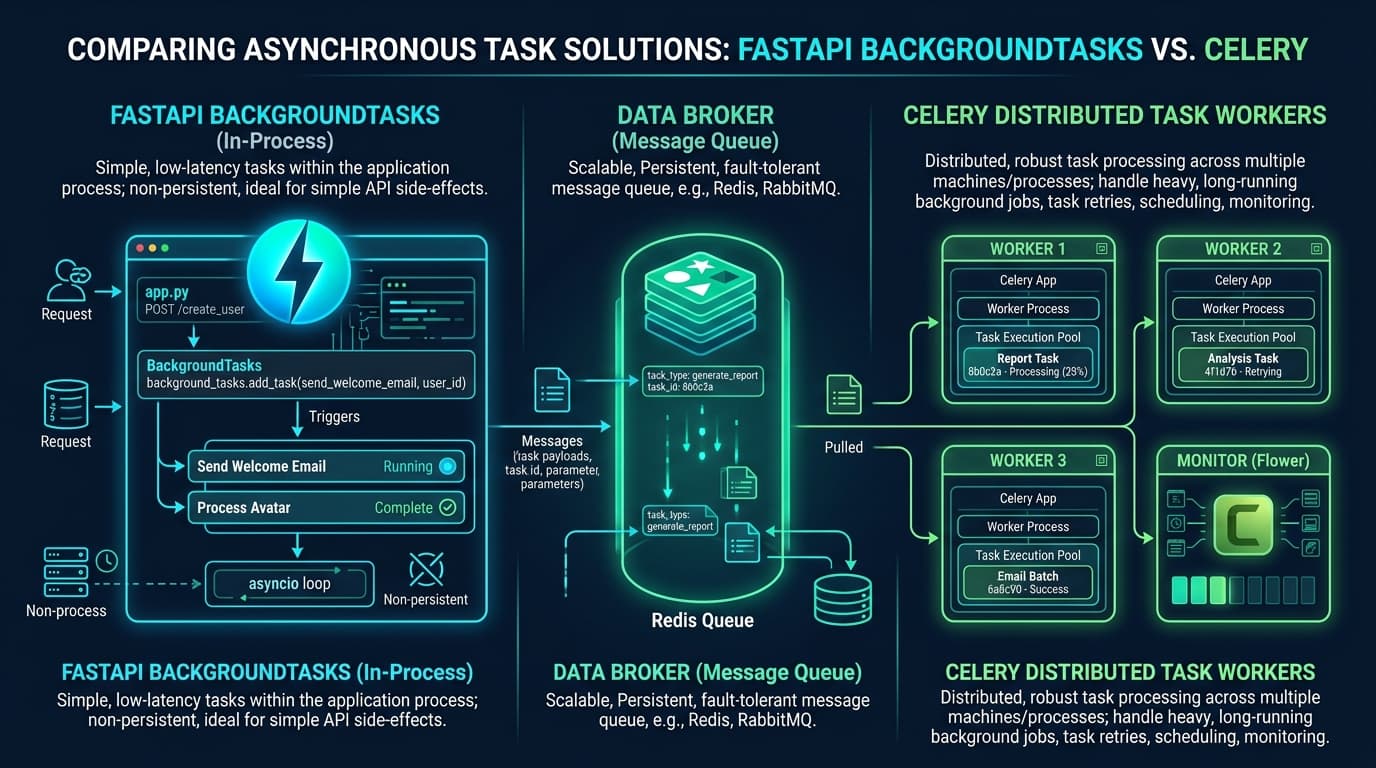
FastAPI vs Celery: When to Use BackgroundTasks vs Distributed Task Queues
FastAPI BackgroundTasks vs Celery: architectural trade-offs, event-loop blocking risks, Redis message brokers, memory benchmarks, and when to switch.
Read more
Serverless vs Edge Computing
A comprehensive architectural comparison of serverless computing and edge runtimes: latency profiles, cold start mitigation, data gravity, and cost tradeoffs.
Read more