Edge Computing in 2026: Real-World Architecture Patterns and Use Cases


Table of Contents
- The Shift from Centralized Cloud to Edge Isolate Runtimes
- 1. Edge-Side Dynamic Personalization with HTMLRewriter
- 2. Real-Time Distributed Collaboration & Cloudflare Durable Objects
- 3. Intelligent AI Inference & Semantic Caching at the Edge
- Global Latency Benchmark: Edge vs Centralized Cloud
- When Is Edge Computing the Wrong Choice?
- Frequently Asked Questions
- What is the difference between an Edge Worker and a Serverless Function?
- How do Edge Workers manage authentication without querying a central database?
- Can Edge Workers communicate directly with relational databases?
- You Might Also Like
For over two decades, "Edge Computing" in web architecture referred strictly to Content Delivery Networks (CDNs) caching static assets—images, stylesheets, and JavaScript bundles—at Points of Presence (PoPs) physically closer to end users.
In 2026, the edge has evolved into a fully distributed, programmable compute environment. Platforms powered by V8 isolates and lightweight WebAssembly runtimes (such as Cloudflare Workers, Fastly Compute@Edge, Vercel Edge Functions, and Deno Deploy) allow developers to execute arbitrary business logic within 10 to 30 milliseconds of any connected device on Earth.
This architectural shift is no longer just about shaving a few milliseconds off a static HTTP GET request. Edge computing enables entirely new classes of distributed applications.
In this guide, we examine the production architectural patterns, real-world use cases, latency benchmarks, and operational tradeoffs of building on modern edge infrastructure.
The Shift from Centralized Cloud to Edge Isolate Runtimes
Traditional cloud computing consolidates compute, databases, and application containers into centralized availability zones (such as AWS us-east-1 in Virginia or eu-central-1 in Frankfurt).
When a user in Singapore or Sydney interacts with an application hosted in Virginia, the speed of light through fiber optic cables imposes a physical latency penalty of 180ms to 240ms per round trip—before your database or backend logic even executes.
[Traditional Cloud Architecture]
  User (Tokyo) ──► (180ms Round Trip) ──► Central Cloud (AWS us-east-1)
                                                 │
                                            Database Query
                                                 │
  User (Tokyo) ◄── (180ms Round Trip) ◄── Response Generated
  Total Network Latency: ~360ms+

[Modern Edge Architecture]
  User (Tokyo) ──► (12ms) ──► Edge PoP (Tokyo Edge Worker)
                                      │
                                 Edge Cache / Durable Object
                                      │
  User (Tokyo) ◄── (12ms) ◄── Streaming Response
  Total Network Latency: ~24ms (15x reduction)
Instead of deploying heavy Docker containers or full virtual machines across 300 data centers, edge platforms utilize V8 Isolates. An isolate is a lightweight JavaScript sandbox that boots in under 5 milliseconds with negligible memory overhead (measured in kilobytes rather than gigabytes), making cold starts virtually nonexistent.
1. Edge-Side Dynamic Personalization with HTMLRewriter
Historically, personalized user experiences required a painful tradeoff:
- Client-Side Rendering: Show a generic layout, download JavaScript, fetch user profile via AJAX, and mutate the DOM (causing noticeable layout shift and Cumulative Layout Shift penalties).
- Server-Side Rendering (SSR): Render HTML dynamically on a centralized server for every request, completely bypassing CDN edge caching.
Modern edge computing resolves this with Edge-Side Streaming HTML Transformation using the HTMLRewriter API. The edge worker fetches a globally cached static HTML shell from the CDN and dynamically modifies specific DOM nodes as the bytes stream to the client:
// Edge Worker: Zero-Flicker Personalization
export default {
  async fetch(request: Request, env: Env): Promise<Response> {
    const url = new URL(request.url);
    const country = request.headers.get('cf-ipcountry') || 'US';
    const authCookie = request.headers.get('cookie') || '';
    const isLoggedIn = authCookie.includes('auth_token=');

    // Fetch the globally cached static HTML page
    const response = await fetch(request);

    // Stream and rewrite the HTML response on-the-fly at the edge
    return new HTMLRewriter()
      .on('div#user-nav', {
        element(el) {
          if (isLoggedIn) {
            el.setInnerContent(
              '<a href="/dashboard" class="btn">Dashboard</a>',
              { html: true }
            );
          } else {
            el.setInnerContent(
              '<a href="/login" class="btn">Sign In</a>',
              { html: true }
            );
          }
        },
      })
      .on('span.local-currency', {
        element(el) {
          const currencySymbol = country === 'GB' ? '£' : country === 'JP' ? '¥' : '$';
          el.setInnerContent(currencySymbol);
        },
      })
      .transform(response);
  },
};
Because HTMLRewriter processes HTML chunks in a single streaming pass using zero-copy Rust parsers (lol-html), time-to-first-byte (TTFB) remains identical to a static cached file.
2. Real-Time Distributed Collaboration & Cloudflare Durable Objects
Traditional multiplayer games or collaborative tools (such as Figma or live whiteboard apps) require persistent WebSocket connections tied to centralized server instances. When users are scattered globally, managing WebSocket connections, pub/sub synchronization, and atomic state updates across regions becomes notoriously difficult.
Edge Actors (Durable Objects) combine compute and strongly consistent localized storage at the edge. When a collaboration session starts, a unique Durable Object instance is instantiated at the edge node closest to the participants:
// Edge Room Coordinator using WebSockets and Durable Storage
export class CollaborativeCanvas {
  state: DurableObjectState;
  sessions: Set<WebSocket>;

  constructor(state: DurableObjectState) {
    this.state = state;
    this.sessions = new Set();
  }

  async fetch(request: Request): Promise<Response> {
    const upgradeHeader = request.headers.get('Upgrade');
    if (!upgradeHeader || upgradeHeader !== 'websocket') {
      return new Response('Expected WebSocket upgrade', { status: 426 });
    }

    const [client, server] = Object.values(new WebSocketPair());
    server.accept();
    this.sessions.add(server);

    server.addEventListener('message', async (event) => {
      const data = JSON.parse(event.data as string);

      // Persist state atomically in localized NVMe storage
      await this.state.storage.put(data.elementId, data);

      // Broadcast position deltas immediately to all connected peers
      for (const socket of this.sessions) {
        if (socket !== server && socket.readyState === WebSocket.OPEN) {
          socket.send(event.data);
        }
      }
    });

    server.addEventListener('close', () => {
      this.sessions.delete(server);
    });

    return new Response(null, { status: 101, webSocket: client });
  }
}
3. Intelligent AI Inference & Semantic Caching at the Edge
Executing heavy Large Language Models (e.g., 70B parameter models) directly on edge CPUs is impossible due to memory constraints. However, edge nodes serve as the ultimate AI Gateway and Semantic Routing Layer:
- Semantic Prompt Caching: Store embeddings of frequently asked user questions in edge vector stores (like Cloudflare Vectorize). If a new query has a 0.96+ cosine similarity with a previous query, the cached answer is returned in 15ms without invoking the upstream LLM.
- Dynamic Model Routing: Analyze input token length and complexity. Route trivial classification queries to ultra-fast local edge models (like Llama-3.2-3B on Workers AI) and route complex reasoning tasks to Claude 3.5 Sonnet or GPT-4o.
Global Latency Benchmark: Edge vs Centralized Cloud
The table below summarizes Time to First Byte (TTFB) and API response latencies measured from four continents targeting an application with edge-deployed logic versus an application deployed in AWS us-east-1 (North Virginia):
| Client Location | Centralized AWS us-east-1 | Modern Edge Worker | Net Latency Improvement |
|---|---|---|---|
| New York, USA | 24 ms | 11 ms | 2.2x faster |
| Frankfurt, Germany | 118 ms | 16 ms | 7.3x faster |
| Tokyo, Japan | 192 ms | 19 ms | 10.1x faster |
| Sydney, Australia | 240 ms | 22 ms | 10.9x faster |
| São Paulo, Brazil | 164 ms | 28 ms | 5.8x faster |
When Is Edge Computing the Wrong Choice?
Despite its advantages, edge computing introduces architectural constraints that require careful consideration:
- Database Connection Pool Exhaustion: If your backend relies on a legacy PostgreSQL or MySQL database without a connection pooler, thousands of concurrent edge workers distributed globally will overwhelm database connection limits. Always utilize database proxies like Prisma Accelerate, Neon Serverless, or Supabase connection poolers.
- CPU Execution Time Limits: Most edge platforms enforce strict CPU time limits (e.g., 50ms of active CPU time per request). Heavy cryptographic proof generation, image manipulation, or batch data crunching belongs on traditional long-running containers.
Frequently Asked Questions
What is the difference between an Edge Worker and a Serverless Function?
Traditional Serverless Functions (like standard AWS Lambda) spin up full Linux containers in a single designated cloud region, incurring cold starts of 200ms to 2,000ms. Edge Workers run inside lightweight V8 isolates distributed across hundreds of global edge data centers, achieving cold starts under 5 milliseconds.
How do Edge Workers manage authentication without querying a central database?
Edge applications use stateless JSON Web Tokens (JWTs) with asymmetric cryptographic signatures (RS256 or EdDSA). The public verification keys are cached in edge memory, allowing edge workers to validate user identity, roles, and permissions in under 1ms without database roundtrips.
Can Edge Workers communicate directly with relational databases?
Yes, using WebSocket-based HTTP drivers or connection pooling proxies (such as Cloudflare Hyperdrive or AWS RDS Proxy). These proxies keep long-lived connection pools active between the edge network and the database origin, eliminating TCP and TLS handshake overhead.
You Might Also Like
Free In-Browser Developer Tools
Clean AI CLI logs, build cron expressions, decode JWTs, and calculate chmod permissions offline.
Related Articles
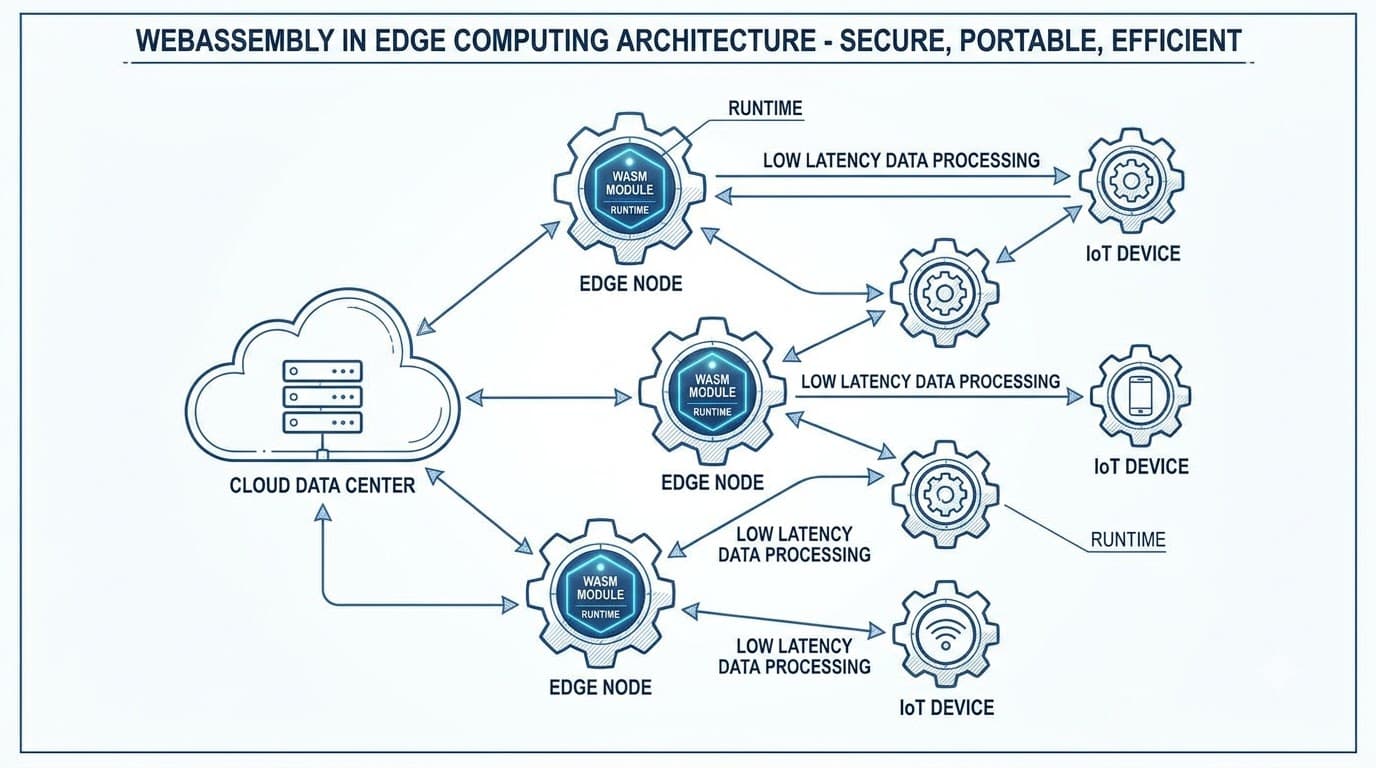
The Future of WebAssembly in Edge Computing: Architecture, WASI 0.2, and Benchmarks
Exploring how WebAssembly (Wasm) and WASI 0.2 are redefining edge computing with microsecond cold starts, capability-based security, and Rust components.
Read more
Edge Computing for Web Developers: What It Actually Is and When to Use It
Edge computing sounds like a marketing buzzword until you actually deploy something there. Here's what it means for web developers, where it genuinely helps, and the gotchas I hit that nobody warned me about.
Read more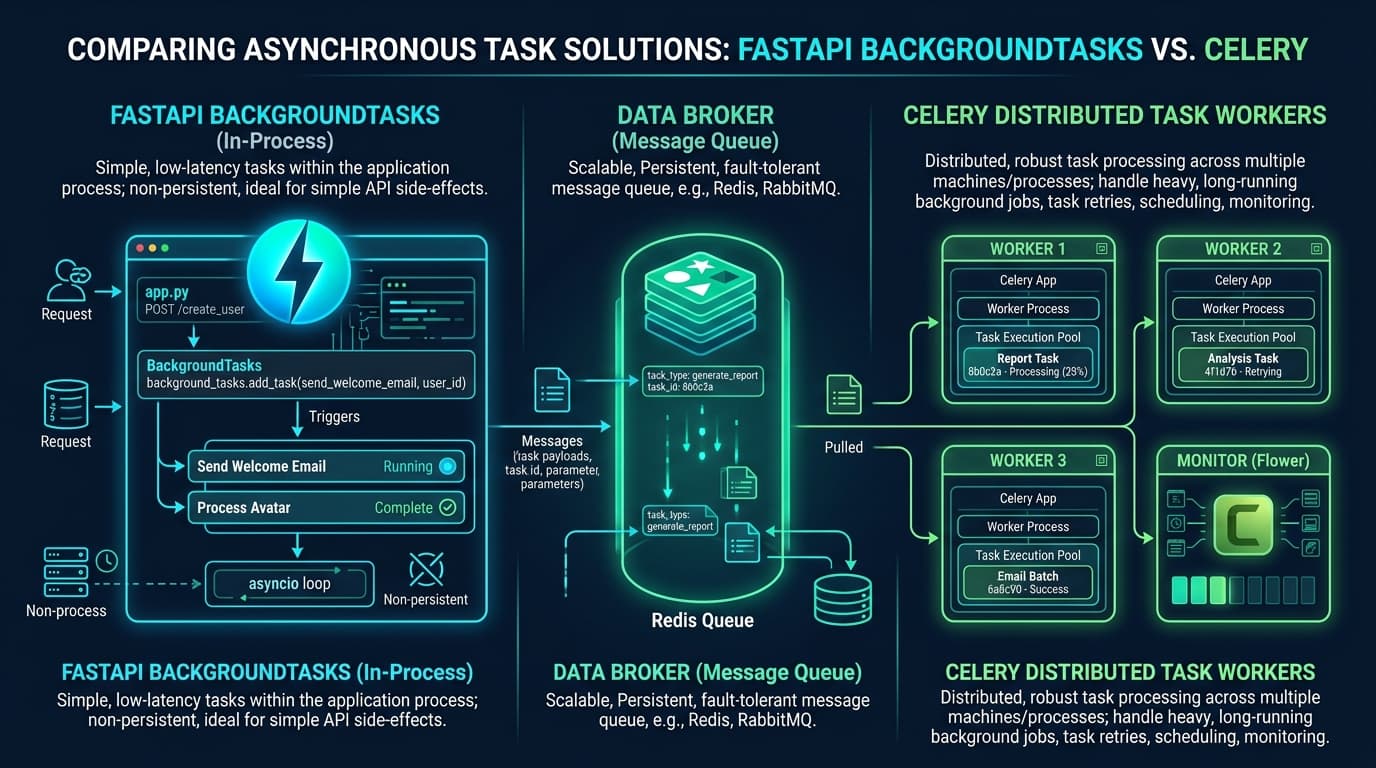
FastAPI vs Celery: When to Use BackgroundTasks vs Distributed Task Queues
FastAPI BackgroundTasks vs Celery: architectural trade-offs, event-loop blocking risks, Redis message brokers, memory benchmarks, and when to switch.
Read more