Advanced TypeScript Patterns for Enterprise Applications


Table of Contents
- 1. Branded Types: Eliminating Primitive Obsession
- The Solution: Nominal "Branding"
- 2. Conditional Types & Return Type Discrimination
- 3. Template Literal Types for Type-Safe Routing
- 4. The satisfies Operator vs Type Assertions (as)
- 5. Exhaustive Pattern Matching with the never Type
- Frequently Asked Questions
- Conclusion
- You Might Also Like
TypeScript has established itself as the undisputed lingua franca of large-scale web engineering. However, in many enterprise codebases, teams merely scratch the surface—treating TypeScript as little more than "JavaScript with interfaces."
When developers rely exclusively on basic types (string, number, Record<string, any>), they allow subtle domain errors, invalid state transitions, and unsafe type assertions to bleed into production.
To build resilient, self-documenting enterprise applications, developers must leverage TypeScript's expressive type-level programming capabilities.
This guide explores advanced TypeScript patterns that eliminate entire categories of runtime bugs: Branded Types, Conditional Types with infer, Template Literal Route Parsers, and the satisfies operator.
1. Branded Types: Eliminating Primitive Obsession
In enterprise systems, entities are frequently represented by primitive types: UserId, OrderId, AccountId, and CurrencyCode are all fundamentally strings or numbers.
Standard TypeScript uses structural typing. If two types have the same underlying shape (string), TypeScript considers them completely interchangeable:
// THE DANGEROUS DEFAULT: Primitive Obsession
function transferFunds(senderId: string, recipientId: string, amountCents: number) {
  // Logic...
}

const customerId = "cust_123";
const vendorId = "vend_456";

// ACCIDENTAL BUG: Parameters swapped! TypeScript compiles with ZERO errors:
transferFunds(vendorId, customerId, 5000);
The Solution: Nominal "Branding"
By intersecting a primitive type with a unique phantom property (the "brand"), we force the compiler to treat semantically different strings as completely incompatible types:
// types/branded.ts
declare const __brand: unique symbol;

export type Brand<T, B> = T & { readonly [__brand]: B };

// Domain Types
export type UserId = Brand<string, 'UserId'>;
export type OrderId = Brand<string, 'OrderId'>;
export type Cents = Brand<number, 'Cents'>;

// Validated Constructors / Type Guards
export function parseUserId(raw: string): UserId {
  if (!raw.startsWith('usr_')) {
    throw new Error(`Invalid UserId format: ${raw}`);
  }
  return raw as UserId;
}

export function toCents(dollars: number): Cents {
  if (dollars < 0) throw new Error('Amount cannot be negative');
  return Math.round(dollars * 100) as Cents;
}
Now, the compiler acts as a ruthless domain guardian:
function chargeCustomer(user: UserId, amount: Cents) {
  // ...
}

const rawId = "usr_987";
// chargeCustomer(rawId, 1000);
// ❌ ERROR: Argument of type 'string' is not assignable to parameter of type 'UserId'.

const validUser = parseUserId(rawId);
const validAmount = toCents(10.00);

chargeCustomer(validUser, validAmount); // ✅ COMPILES SAFELY
2. Conditional Types & Return Type Discrimination
When writing SDKs or API client libraries, the shape of a returned payload often depends on the input options. For instance, requesting an entity with includeAuditLog: true should return an object containing the audit log array, whereas includeAuditLog: false should omit it.
Using conditional types with the ternary syntax (T extends U ? X : Y), you can enforce dynamic return shapes without method overloading boilerplate:
interface AuditRecord {
  timestamp: number;
  actor: string;
}

interface BaseCustomer {
  id: string;
  name: string;
}

interface CustomerWithAudit extends BaseCustomer {
  auditLog: AuditRecord[];
}

interface FetchOptions {
  includeAudit?: boolean;
}

// Dynamic Return Type Calculation
export type CustomerResponse<T extends FetchOptions> =
  T extends { includeAudit: true } ? CustomerWithAudit : BaseCustomer;

export async function getCustomer<T extends FetchOptions>(
  id: string,
  options?: T
): Promise<CustomerResponse<T>> {
  const res = await fetch(`/api/customers/${id}?audit=${options?.includeAudit ?? false}`);
  return res.json();
}

// USAGE:
async function run() {
  // TypeScript infers return type as BaseCustomer:
  const simple = await getCustomer('cust_1', { includeAudit: false });
  // simple.auditLog; // ❌ Property 'auditLog' does not exist on type 'BaseCustomer'.

  // TypeScript infers return type as CustomerWithAudit:
  const detailed = await getCustomer('cust_2', { includeAudit: true });
  console.log(detailed.auditLog.length); // ✅ Fully typed!
}
3. Template Literal Types for Type-Safe Routing
Template Literal Types allow TypeScript to parse and manipulate string literals at compile time.
Imagine building a custom client router. You want to pass a route path like /users/:userId/orders/:orderId and have TypeScript automatically infer that the parameters object must contain { userId: string; orderId: string }:
// Recursive Path Parameter Extractor
type ExtractParams<Path extends string> =
  Path extends `${string}:${infer Param}/${infer Rest}`
    ? { [K in Param | keyof ExtractParams<`/${Rest}`>]: string }
    : Path extends `${string}:${infer Param}`
    ? { [K in Param]: string }
    : Record<string, never>;

// Type Verification Tests:
type RouteA = ExtractParams<"/dashboard">;
// Result: Record<string, never> (Empty object)

type RouteB = ExtractParams<"/orgs/:orgId/members/:memberId">;
// Result: { orgId: string; memberId: string; }

// Implementation of Type-Safe API Client:
function createRoute<P extends string>(path: P) {
  return {
    buildUrl(params: ExtractParams<P>): string {
      let url: string = path;
      for (const [key, value] of Object.entries(params)) {
        url = url.replace(`:${key}`, encodeURIComponent(value as string));
      }
      return url;
    }
  };
}

const userOrderRoute = createRoute("/api/users/:userId/orders/:orderId");

// userOrderRoute.buildUrl({ userId: "10" });
// ❌ ERROR: Property 'orderId' is missing in type '{ userId: string; }'.

const url = userOrderRoute.buildUrl({ userId: "10", orderId: "ord_99" });
// ✅ Output: "/api/users/10/orders/ord_99"
4. The satisfies Operator vs Type Assertions (as)
One of the most dangerous keywords in TypeScript is as (type casting). Writing const data = payload as User completely silences the compiler, masking missing properties or runtime shape mismatches.
Introduced in TypeScript 4.9, the satisfies operator validates that an expression matches a type without widening or changing the inferred type:
type Color = 'red' | 'green' | 'blue' | [number, number, number];

type ThemeConfig = Record<'primary' | 'secondary', Color>;

// PROBLEM WITH ANNOTATION (: ThemeConfig):
// Widens the types to 'Color', so we lose exact string literal knowledge!
const themeAnnotated: ThemeConfig = {
  primary: 'red',
  secondary: [0, 255, 0]
};
// themeAnnotated.primary.toUpperCase(); // ❌ ERROR: Property 'toUpperCase' does not exist on type '[number, number, number]'.

// THE WINNER: `satisfies`
const themeWithSatisfies = {
  primary: 'red',
  secondary: [0, 255, 0]
} satisfies ThemeConfig;

// 1. Catches invalid keys at compile time:
// { accent: 'purple' } satisfies ThemeConfig; // ❌ ERROR: Object literal may only specify known properties.

// 2. Preserves exact inferred types:
console.log(themeWithSatisfies.primary.toUpperCase()); // ✅ Valid! Inferred as string literal 'red'.
console.log(themeWithSatisfies.secondary.map(v => v * 2)); // ✅ Valid! Inferred as tuple [number, number, number].
5. Exhaustive Pattern Matching with the never Type
When modeling complex domain workflows (such as payment processing states), TypeScript discriminated unions shine. However, if a developer adds a new state variant ('REFUNDED') to the union and forgets to handle it in a switch statement, the code will fail silently at runtime.
By leveraging the never type, we force the TypeScript compiler to throw an error whenever an unhandled case exists:
type PaymentState =
  | { status: 'PENDING'; expiresAt: number }
  | { status: 'SUCCESS'; transactionId: string }
  | { status: 'FAILED'; reason: string }
  | { status: 'REFUNDED'; refundId: string }; // Newly added state!

function handlePayment(event: PaymentState): string {
  switch (event.status) {
    case 'PENDING':
      return `Waiting for payment until ${event.expiresAt}`;
    case 'SUCCESS':
      return `Processed transaction: ${event.transactionId}`;
    case 'FAILED':
      return `Payment failed: ${event.reason}`;
    case 'REFUNDED':
      return `Refund issued: ${event.refundId}`;
    default: {
      // EXHAUSTIVE CHECK:
      // If any union variant is unhandled, `event` is NOT `never`, and this line fails compilation!
      const _unreachable: never = event;
      throw new Error(`Unhandled payment state: ${JSON.stringify(_unreachable)}`);
    }
  }
}
Frequently Asked Questions
Conclusion
Advanced TypeScript is not about writing obscure, unreadable type gymnastics to impress colleagues. It is about constructing unbreakable architectural contracts.
By replacing raw strings with Branded Types, validating API shapes with Conditional Types, using Template Literals for type-safe routing, and guarding data structures with satisfies, you transform TypeScript from a basic linter into an impenetrable defense system against production defects.
You Might Also Like
Free In-Browser Developer Tools
Clean AI CLI logs, build cron expressions, decode JWTs, and calculate chmod permissions offline.
Related Articles

TypeScript Generics: Advanced Patterns for Type-Safe APIs
Master advanced TypeScript generics patterns: conditional types, mapped types, distributive infer constraints, and building type-safe production libraries.
Read more
JavaScript to Luau: Roblox Scripting for Web Developers
Learn Roblox scripting coming from JavaScript and TypeScript: Complete syntax mapping table, 1-based indexing, coroutines, and roblox-ts development.
Read more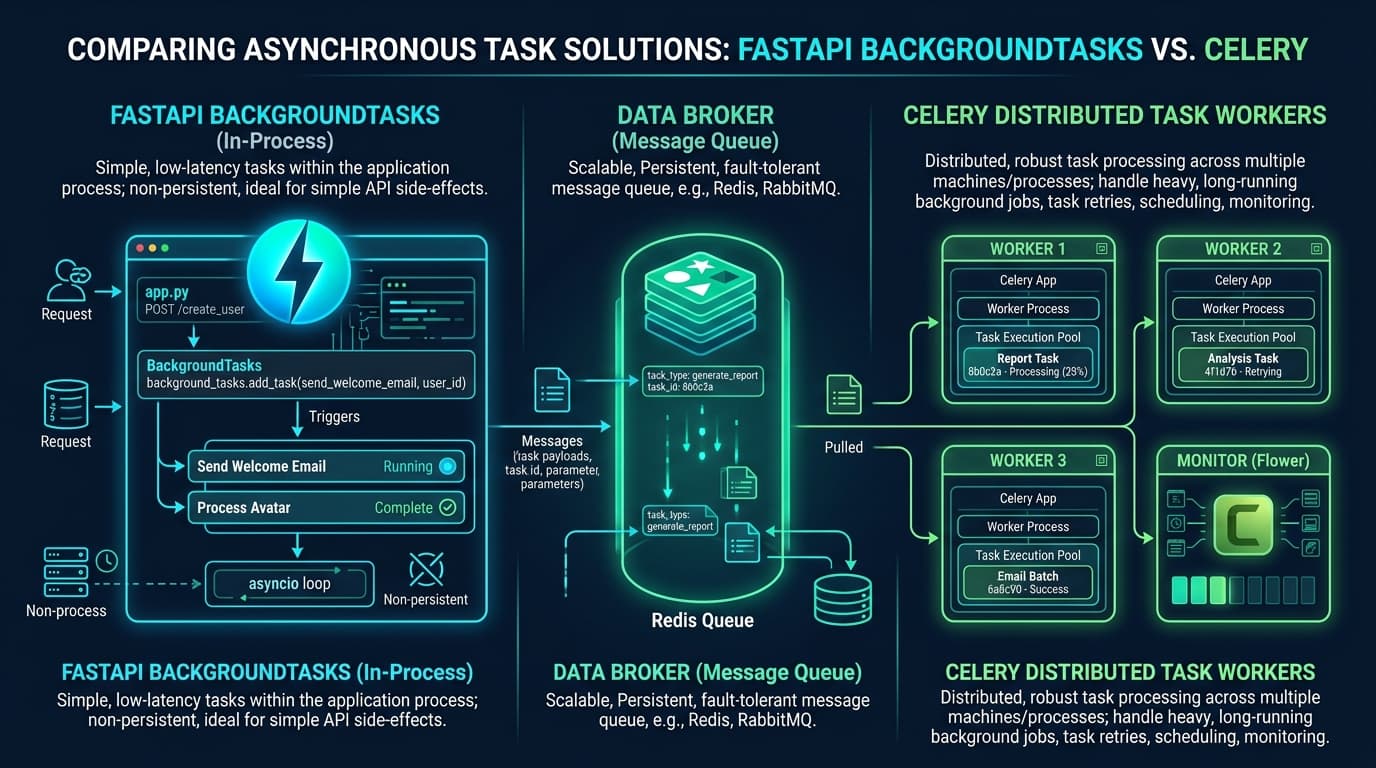
FastAPI vs Celery: When to Use BackgroundTasks vs Distributed Task Queues
FastAPI BackgroundTasks vs Celery: architectural trade-offs, event-loop blocking risks, Redis message brokers, memory benchmarks, and when to switch.
Read more