The Paradigm Shift of React Server Components
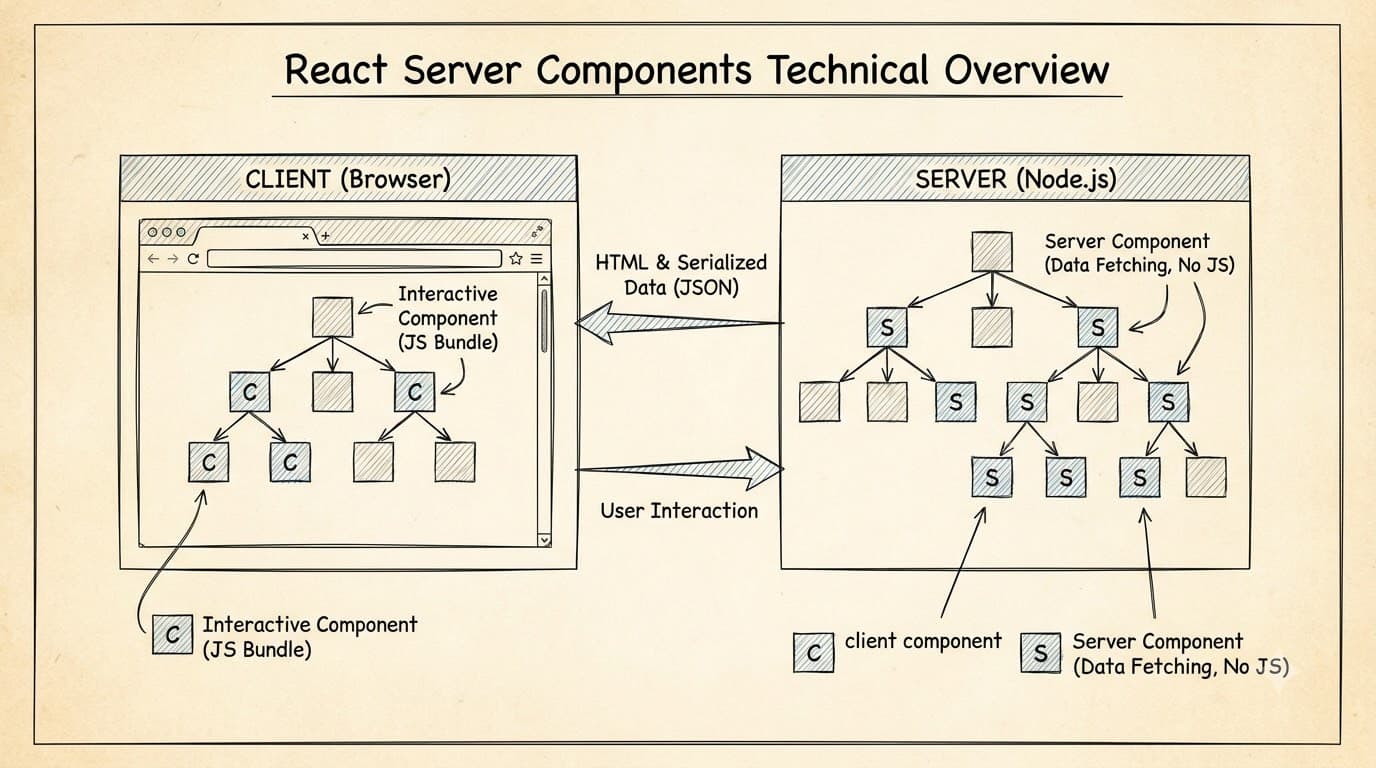

Table of Contents
For the past decade, React has been synonymous with client-side rendering (CSR). Developers became accustomed to sending large JavaScript bundles to the browser, fetching data on the client, and managing complex global states just to render a page. While techniques like Server-Side Rendering (SSR) and Static Site Generation (SSG) helped improve initial load times, they still relied heavily on client-side hydration, which often lead to bloated JavaScript payloads and sluggish interactivity on low-end devices.
Now, the React ecosystem is undergoing one of its most significant transformations since the introduction of Hooks: the widespread adoption of React Server Components (RSC). RSCs represent a fundamental paradigm shift in how we architect, build, and optimize React applications.
In this deep dive, we will explore what React Server Components actually are, the specific problems they solve, and how they bridge the historical gap between robust server-side infrastructure and dynamic client-side interactivity.
Rethinking the Render Environment
To understand the impact of React Server Components, we must first understand the traditional React rendering lifecycle. In a standard React application (even one using SSR), components are ultimately designed to run in the browser. When a user navigates to a page, the server might send down the initial HTML, but the browser still has to download the corresponding React components (and all their dependencies), parse the JavaScript, and "hydrate" the page to make it interactive.
React Server Components challenge this default behavior by explicitly defining components that only execute on the server. They never ship their code to the client. This simple distinction has massive implications for application architecture.
By moving rendering back to the server — but maintaining the component-based model we love — developers can leverage server infrastructure directly without exposing sensitive credentials or bloating the client bundle.
The Core Benefits of Server Components
React Server Components bring several crucial advantages that drastically improve both the developer experience and the end-user experience.
1. Zero Bundle Size Impact
This is perhaps the most celebrated feature of RSCs. Because Server Components never execute in the browser, their source code and all of their dependencies are completely excluded from the JavaScript bundle sent to the user.
Imagine a component that imports a heavy markdown parsing library or an enormous date-formatting utility like Moment.js. In a traditional React app, those heavy libraries are downloaded and parsed by every single user's browser. With Server Components, that heavy lifting happens entirely on the server. The server simply sends the pre-rendered UI (a serialized virtual DOM format) to the client. The client gets the final UI without downloading a single byte of the libraries used to generate it.
2. Direct Backend Access
Because Server Components run natively on the server, they have direct, secure access to backend infrastructure. You can query your database, interact with your file system, or communicate with internal microservices directly within your component code.
// Example of a Server Component
import db from './database';

export default async function UserProfile({ userId }) {
  // Direct database access! No API route needed.
  const user = await db.users.find(userId);

  return (
    <div>
      <h1>{user.name}</h1>
      <p>{user.bio}</p>
    </div>
  );
}
This eliminates the need for building intermediary API routes just to fetch data for the frontend. It simplifies the architecture and removes network waterfall issues associated with client-side data fetching.
3. Automatic Code Splitting
In traditional React applications, developers have to manually implement code splitting using React.lazy() and dynamic imports to prevent the initial JavaScript bundle from becoming too large.
React Server Components fundamentally change this. Because the server dictates what UI needs to be rendered, it can automatically and intelligently stream the necessary Client Components to the browser exactly when they are needed. The boundary between server logic and client interactivity handles the code splitting for you, significantly reducing the cognitive load on the developer.
Understanding the Boundaries: Server vs. Client
It is a common misconception that React Server Components are meant to replace Client Components. In reality, they are designed to work together symbiotically.
- Server Components are responsible for data fetching, backend access, and rendering static or non-interactive UI. They cannot use state (
useState), effects (useEffect), or browser-only APIs (likewindoworlocalStorage). - Client Components are the traditional React components we are used to. They handle interactivity, state, event listeners (like
onClick), and browser APIs.
The art of building modern React applications lies in intelligently placing the "use client" directive to draw the boundary between the server and the client. The goal is to push as much rendering as possible to the Server Components at the top of the tree, and only push interactive islands (Client Components) down to the leaves of the tree.
The Streaming Advantage
RSCs heavily leverage React's concurrent rendering and streaming capabilities. Instead of waiting for the entire page to render on the server before sending a response, the server can stream chunks of the UI to the browser as soon as they are ready.
This means a user can see the layout, navigation, and static content immediately, while heavier data-dependent sections of the page load incrementally. When combined with React Suspense, developers can create incredibly fluid, fast, and responsive user experiences, even on slow connections.
Looking Ahead
The transition to React Server Components represents a maturation of the React ecosystem. By acknowledging that not all UI needs to be interactive, and by leveraging the power of server environments, React is solving the JavaScript bloat problem that has plagued modern web development.
Frameworks like Next.js (with the App Router) and Waku are already heavily invested in this new architecture, proving that RSCs are ready for production. While the learning curve requires a mental shift in how we structure components and handle data, the resulting improvements in performance, simplicity, and user experience make React Server Components a defining shift in the future of web development.
You Might Also Like
Free In-Browser Developer Tools
Clean AI CLI logs, build cron expressions, decode JWTs, and calculate chmod permissions offline.
Related Articles

Modern React Testing with Vitest and React Testing Library
A comprehensive guide on migrating from Jest to Vitest for modern React applications. Learn how to leverage Vitest's speed and native ESM support alongside React Testing Library to write resilient, maintainable test suites.
Read more
State Management in React 2026: Beyond Redux
Comprehensive guide to React state management in 2026: comparing React 19 actions, TanStack Query server state, Zustand, Jotai, and Signals.
Read more
Mastering SVG in React 19: Performance, Dynamic currentColor & Bundle Optimization
Stop shipping 800kB of unused icon bloat. Master SVGs in React 19 with dynamic currentColor theming, SVG sprite sheets, forwardRef interfaces, and zero-runtime overhead.
Read more